
Table of Contents
In my five years of building AI agents for identity verification, I’ve seen a critical shift. In 2024, deepfakes and AI-generated IDs accounted for nearly a third of all high-risk fraud alerts, a 230% year-on-year surge. This isn’t a future threat; it’s a present reality for U.S. businesses. The United States identity verification market, valued at USD 2.9 Billion in 2024, is a fortress being built in real-time to combat these threats, projected to reach USD 8.9 Billion by 2033.
The question for American businesses is no longer if you need an AI document verification system, but how to choose the right one to protect your customers and your bottom line. Having integrated these systems for dozens of U.S. financial institutions and tech companies, I can confirm that the right solution does more than just check compliance boxes. It builds a fundamental layer of trust in your digital ecosystem.
Looking to Automate and Secure Your Document Verification Process?AI-powered verification can reduce errors, prevent fraud, and speed up approvals — but implementation varies by organization. Book a free 30-minute consultation with our AI and cloud experts to see how your business can benefit from automated document verification. 👉 Book My Free AI Verification ConsultationNo obligation — just actionable insights tailored to your workflow. |
This guide will dissect the key features, leading providers, and strategic considerations you need to navigate the AI document verification landscape in the United States.
The best AI document verification service for your U.S. business combines robust regulatory compliance, advanced liveness detection, and a seamless user experience to combat next-generation fraud.
Why AI Document Verification is Non-Negotiable for U.S. Businesses in 2025
The digital transformation of the American economy has made secure remote onboarding a baseline requirement. The U.S. identity verification market is projected to grow from USD 4.4 billion in 2025 to USD 16.7 billion by 2034, a compound annual growth rate (CAGR) of 15.9%.
This growth is fueled by three powerful forces:
The Staggering Cost of Identity Fraud
Identity fraud is a multi-billion-dollar problem on American soil. In 2024 alone, identity fraud and scams cost Americans approximately $47 billion. For businesses, the financial impact is compounded. For every $1 lost in online fraud, financial services firms in the U.S. lose an additional $4 in penalties, making prevention a top financial priority. The rise of generative AI has weaponized this threat, enabling fraudsters to create hyper-realistic, forged documents at scale.
An Evolving Regulatory Maze
U.S. businesses must navigate a complex web of regulations, and the stakes for non-compliance are severe.
- FinCEN’s BOI Rule: Effective January 1, 2024, this rule requires reporting companies to collect and verify beneficial ownership information, directly impacting KYC workflows.
- Sector-Specific Rules: Financial institutions are bound by strict KYC (Know Your Customer) and AML (Anti-Money Laundering) mandates. The healthcare sector must comply with HIPAA, and all businesses handling California residents’ data must adhere to the CCPA.
- Global Standards: Even U.S.-only companies must often build systems that comply with standards like Europe’s eIDAS 2.0 if they have international ambitions.
The Demand for Frictionless User Experience
Security cannot come at the cost of usability. American consumers have little patience for clunky onboarding. Research shows that 57% of consumers are willing to share their data when it enhances security and prevents fraud. Modern AI-powered verification completes checks in seconds, a critical factor in reducing user drop-off and building positive brand perception from the first interaction.
How AI-Powered Document Verification Works: A Technical Breakdown
From an engineering perspective, a best-in-class system operates through a seamless, automated pipeline.
Here’s a look under the hood of the AI agents we build for this purpose.
Step 1: Document Capture and Data Extraction
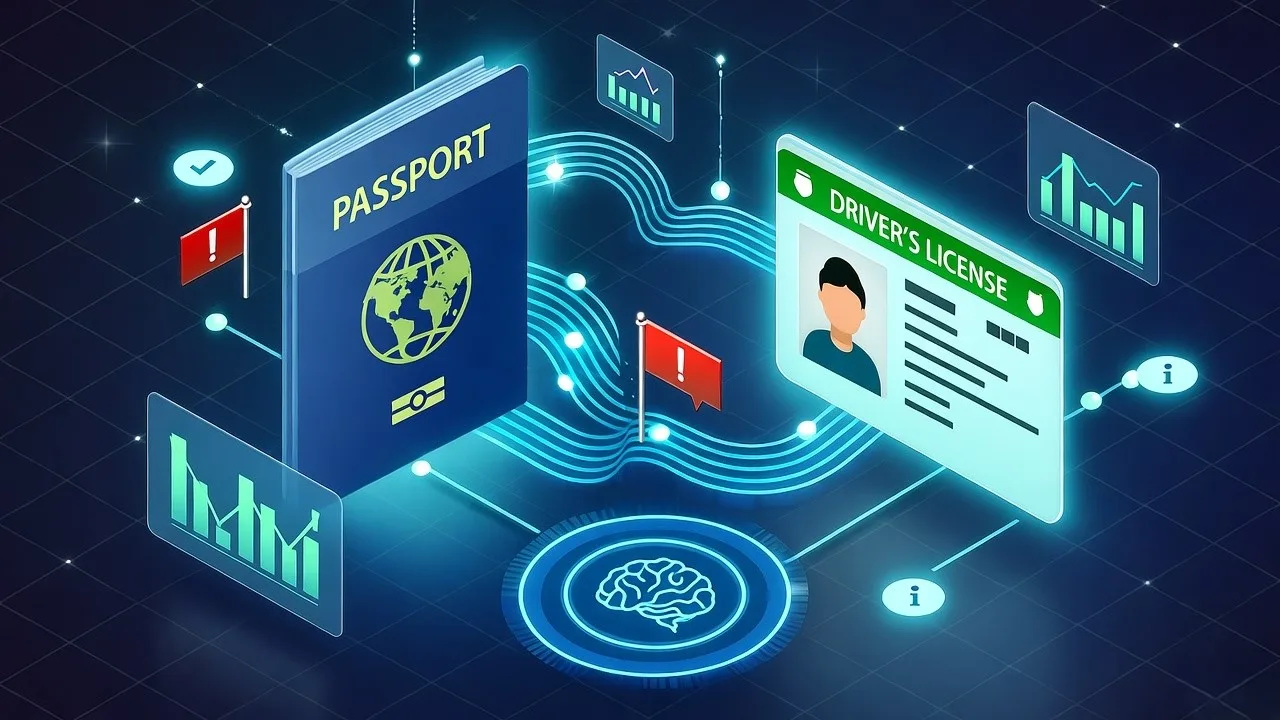
The process begins when a user uploads a photo of their government-issued ID, such as a driver’s license or passport. Advanced systems use Optical Character Recognition (OCR) technology to instantly read and extract all the text data from the document. The best providers support over 5,000 document types from 200+ countries, ensuring global coverage for U.S. companies with an international user base. This stage also involves an initial check for basic authenticity by analyzing security features.
Step 2: AI-Powered Document Authentication
This is where the core AI magic happens. The system doesn’t just read the text; it analyzes the document itself for signs of tampering or forgery.
- Computer Vision Analysis: The AI examines hundreds of data points, including fonts, micro-printing, holograms, and UV light patterns, comparing them against known genuine templates.
- Fraud Pattern Recognition: Machine learning models, trained on millions of global ID scans, can flag “micro-forgeries invisible to the human eye”. These systems retrain as frequently as every 72 hours to adapt to new fraudulent techniques.
Step 3: Biometric Verification and Liveness Detection
To ensure the person presenting the document is its legitimate owner and is physically present, the system requests a selfie.
- Facial Matching: AI compares the selfie to the photo on the ID document to ensure a match.
- Liveness Detection: This is a critical defense against sophisticated spoofing. The technology confirms that the source is a live person, not a photo, video, or deepfake. Modern liveness detection can track facial movements and check for 3D consistency, with some systems achieving a “10X improvement in anti-spoofing performance”.
Step 4: Fraud Prevention and Compliance Checks
Finally, the extracted user data is cross-referenced against various databases.
- Watchlist Screening: The system checks against global AML watchlists, sanctions lists, and Politically Exposed Persons (PEP) lists.
- Risk Scoring: Many platforms generate a comprehensive risk score based on the user’s identity data and behavior, allowing businesses to flag suspicious patterns for manual review.
Key Features to Evaluate in a U.S. AI Document Verification Service
Not all providers are created equal. Based on our internal benchmarking, here are the non-negotiable features for a U.S. deployment.
→ Security and Fraud Detection Capabilities
- Advanced Liveness Detection: Ensure the provider uses active or passive liveness checks to defeat presentation attacks.
- Document Fraud Detection: The AI must be trained to detect forgeries, including those created by GANs (Generative Adversarial Networks).
- Data Encryption: All data, in transit and at rest, should be protected with robust encryption standards like AES-256.
→ Compliance and Regulatory Alignment
- Built-in Compliance Intelligence: Look for solutions with policy engines that map verification against jurisdiction-specific rules like the FinCEN BOI Rule and AML requirements, triggering real-time pass/fail decisions.
- Data Residency Options: For businesses in regulated industries, the ability to choose data storage locations (e.g., U.S.-only servers) is crucial.
→ Accuracy and Global Coverage
- High Accuracy Rates: Leading providers boast document classification accuracy of 99%+ with a false-rejection rate of less than 1%, even on non-Latin scripts.
- Broad Document Library: Your provider must support all common U.S. documents (state IDs, driver’s licenses, passports) and, if needed, a wide range of international ones.
→ User Experience and Integration
- Verification Speed: The entire process, from document upload to result, should take under 30-60 seconds.
- “Course Correction” Features: The system should guide users with clear feedback if a selfie is blurry or a document is cut off, reducing user frustration and drop-offs.
- Seamless Integration: Look for API-first solutions with well-documented SDKs for web and mobile that your team can integrate in days, not months.
→ Technical Performance and Support
- Uptime and Reliability: The service should guarantee at least 99.9% uptime.
- Scalability: The platform must handle your peak verification volumes without performance degradation.
- Real-time Support: 24/7 support availability is essential for resolving any issues that could block user onboarding.
A Strategic Framework for Choosing Your Provider
Selecting a vendor is a strategic decision. I advise clients to follow this structured approach.
- Audit Your Specific Needs: Don’t buy features you don’t need. A B2C fintech startup has different risk and compliance requirements than a B2B SaaS platform serving large enterprises. Define your primary use case: customer onboarding, employee verification, or continuous transaction monitoring.
- Prioritize U.S. Compliance: Ensure the provider has a proven track record of helping U.S. businesses meet KYC, AML, and CCPA requirements. Ask for specific case studies or compliance documentation.
- Conduct a Proof-of-Concept (PoC): Never buy based on a sales demo alone. Run a structured PoC using your own real-world data and scenarios. Test for accuracy, speed, and user experience with a diverse set of IDs.
- Evaluate Total Cost of Ownership (TCO): Look beyond per-verification pricing. Consider implementation fees, support costs, and any potential integration expenses. Scalable, usage-based pricing is often most sustainable for growing businesses.
- Assess Long-Term Viability: In a rapidly consolidating market, choose a provider with a clear innovation roadmap and financial stability. You are building a foundational security layer, not just implementing a point solution.
The Future of AI Document Verification in the United States
The technology is evolving rapidly. Based on our R&D work, we see three dominant trends shaping the next 2-3 years:
- The Battle Against Deepfakes: Verification systems will increasingly incorporate specialized AI models designed solely to detect AI-generated synthetic media and identity fraud.
- The Rise of Digital Wallets: With regulations like eIDAS 2.0 in Europe setting a precedent, the U.S. will see growing adoption of verifiable digital credentials and wallets, shifting some verification from physical documents to cryptographically secure digital claims.
- Decentralized Identity: Blockchain-based identity models, where users control their own verified data, will move from concept to pilot, promising greater user privacy and reduced liability for businesses.
Building Trust in the Digital Age
In the United States’ competitive digital landscape, a robust AI document verification system is not an IT cost but a strategic investment. It directly protects revenue, ensures regulatory compliance, and builds the foundational trust that lasting customer relationships are built upon. The market offers mature, powerful solutions; the key is to select one that aligns perfectly with your business’s unique risk profile, user expectations, and growth trajectory.
The core takeaway is this: In 2025, the question is not about verifying identity but about doing so in a way that is secure, seamless, and intelligent enough to stay ahead of the threats of tomorrow.
People Also Ask
What is the difference between identity verification and a background check?
Identity verification confirms that a person’s identity is real and that they are who they claim to be at that moment, using documents and biometrics. A background check delves into a person’s history, such as their criminal record, employment, and education
How accurate is AI document verification?
Leading AI verification services are highly accurate, with top providers achieving document classification accuracy of 99%+ and false-rejection rates of less than 1%, making them far more reliable than manual checks
Is AI-based verification secure and privacy-centric?
Yes, enterprise-grade solutions employ end-to-end encryption, offer data residency options, and support on-premises deployments, ensuring sensitive user data never leaves your controlled environment and is protected from breaches
Which U.S. industries use AI document verification the most?
The primary sectors are Banking, Financial Services, and Insurance (BFSI), followed by government, healthcare, e-commerce, and telecommunications, all of which have strict compliance and security needs
NunarIQ — The All-in-One AI Agent Platform Driving Efficiency, Precision, and Growth
NunarIQ equips GCC enterprises with AI agents that streamline operations, cut 80% of manual effort, and reclaim more than 80 hours each month, delivering measurable 5× gains in efficiency.
Industries
- Logistics
- Retail
- Manufacturing
- Healthcare
- Finance
- Energy & Resources
Resources
- Blogs
- Whitepaper
- Knowledge Base
- AI Agent Requirement Analysis