
Table of Contents
AI in Chemical Manufacturing: Powering the Next Era of Smart Production in the U.S.
The chemical industry is one of the most data-intensive sectors in the world. Every process, from raw material selection to reaction control and quality assurance, generates vast amounts of information. Yet for decades, much of that data remained underused. That’s changing fast.
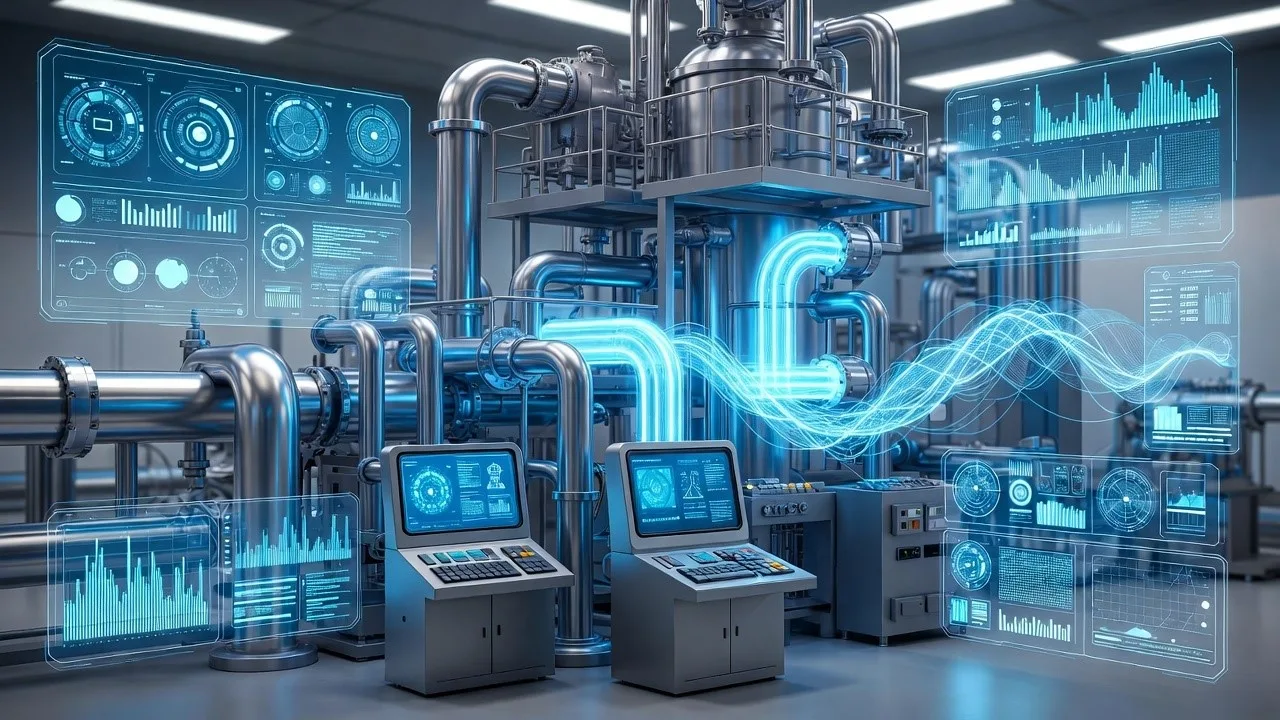
Today, artificial intelligence (AI) is reshaping how U.S. chemical manufacturers design, produce, and optimize materials. With AI models analyzing patterns and predicting outcomes in real time, chemical plants are becoming safer, more efficient, and more sustainable.
This isn’t a distant vision, it’s already happening across the country, from advanced polymers and fertilizers to specialty chemicals and pharmaceuticals.
How AI Is Transforming the Chemical Manufacturing Landscape
AI brings computational intelligence to processes once governed by fixed rules and manual oversight. It’s not replacing chemical engineers; it’s empowering them with predictive insight and process autonomy.
Core applications include:
- Predicting chemical reactions and yields before physical trials.
- Optimizing process parameters to improve efficiency.
- Detecting equipment anomalies before breakdowns.
- Reducing waste and emissions with precise energy modeling.
- Accelerating R&D with AI-driven molecular design.
In short, AI turns complex chemical processes into self-learning systems capable of making data-backed decisions faster than any human could.
1) AI in Process Optimization
Chemical manufacturing depends heavily on consistent process control—temperature, pressure, and reaction times must stay within narrow limits.
AI-powered systems analyze streams of sensor data to detect subtle fluctuations and adjust parameters automatically.
For example, a neural network trained on years of process data can:
- Predict yield losses before they happen.
- Recommend adjustments to maintain purity levels.
- Balance throughput and energy use to optimize efficiency.
A refinery in Texas, for instance, used AI to monitor distillation columns and achieved a 12% reduction in energy costs within six months.
2. Predictive Maintenance in Chemical Plants
Downtime in chemical production is costly, both financially and environmentally. Predictive maintenance powered by AI prevents this by identifying early signs of mechanical failure.
Machine learning models analyze sensor data such as vibration, pressure, and heat to forecast equipment degradation.
This means:
- Pumps and valves are replaced before failure.
- Operators receive maintenance alerts automatically.
- Plants reduce unplanned outages and extend asset lifespans.
In one U.S. ammonia production facility, AI-driven predictive maintenance reduced unscheduled shutdowns by 40%, improving overall equipment efficiency (OEE).
3. Quality Control with Computer Vision and Data Analytics
AI plays a vital role in maintaining product consistency—especially in large-scale chemical production where even minor deviations can alter outcomes.
Using computer vision and spectral analysis, AI models detect impurities, inconsistencies, or color deviations in real time.
This approach:
- Reduces human error in inspection.
- Cuts material waste.
- Enables continuous production with automated quality verification.
AI also identifies root causes of quality variation—helping engineers correct problems immediately instead of after a batch is complete.
4. AI-Driven Chemical R&D and Product Innovation
One of the biggest revolutions AI brings to the industry is in research and development.
Traditional R&D in chemistry relies on experimentation, often taking months or years to find optimal compounds. AI accelerates this process dramatically.
Machine learning algorithms can:
- Predict molecular properties and reactivity.
- Suggest new formulations or catalysts.
- Simulate reactions digitally before lab trials.
AI models such as deep neural networks are now helping scientists discover novel polymers, corrosion inhibitors, and specialty chemicals faster, with lower development costs.
5. Supply Chain and Inventory Optimization
AI extends beyond the production floor into logistics and supply chain management.
For chemical manufacturers, supply chain reliability is crucial because raw materials often have strict handling requirements or limited shelf life.
AI systems help by:
- Forecasting demand based on customer orders and market trends.
- Optimizing inventory levels to minimize storage and waste.
- Predicting disruptions (e.g., weather, shipment delays) and rerouting materials dynamically.
A U.S.-based specialty chemical company implemented AI-driven forecasting and achieved a 25% reduction in raw material holding costs.
6. Environmental Sustainability and Energy Efficiency
Sustainability is now a core business goal in U.S. manufacturing. AI helps the chemical industry meet EPA and ESG compliance requirements while improving profitability.
AI-powered systems can:
- Monitor emissions in real time.
- Optimize reaction temperatures to lower energy use.
- Identify inefficiencies in heat exchange or waste treatment systems.
- Suggest process modifications to reduce carbon footprint.
For example, AI models in a polymer plant analyzed process energy flows and helped cut greenhouse gas emissions by 10% within the first year.
7. Integrating AI into MES and DCS Systems
Most chemical plants already operate with Manufacturing Execution Systems (MES) or Distributed Control Systems (DCS). AI can integrate seamlessly into these environments to enable smarter control.
Examples of integration:
- Embedding AI models directly into control loops for dynamic optimization.
- Using AI dashboards to visualize process health and predictive KPIs.
- Running “what-if” simulations to assess impact of raw material changes or demand spikes.
This creates a unified, intelligent plant environment, sometimes referred to as a Cognitive Manufacturing System, that continuously learns and adapts.
Key Benefits of AI in Chemical Manufacturing
| Benefit | Description |
|---|---|
| Predictive Decision-Making | AI models forecast process outcomes and performance trends in real time. |
| Operational Efficiency | Optimizes throughput, minimizes downtime, and reduces waste. |
| Enhanced Safety | Predicts safety hazards through anomaly detection. |
| Sustainability | Reduces energy consumption and supports green manufacturing. |
| Faster R&D Cycles | Accelerates innovation through AI-driven simulations. |
| Cost Savings | Cuts maintenance, resource, and energy costs significantly. |
Challenges in Implementing AI
Despite its potential, AI adoption in chemical manufacturing presents challenges:
- Data silos between lab, plant, and enterprise systems.
- Legacy equipment without IoT connectivity.
- High initial investment in data infrastructure and model training.
- Regulatory constraints on automation in hazardous processes.
However, U.S. manufacturers that overcome these hurdles are seeing rapid ROI, often within 12 to 18 months—through cost savings and efficiency gains.
Future Outlook: AI and the Rise of Autonomous Plants
The future of chemical manufacturing lies in autonomous production ecosystems, plants that can self-correct, self-optimize, and even self-report sustainability metrics.
With AI agents handling process control, quality assurance, and logistics coordination, manufacturers will move from reactive to predictive—and eventually to prescriptive, operations.
As edge AI and cloud computing converge, real-time optimization will become the standard, not the exception. The result? Safer, cleaner, and smarter chemical plants across the United States.
People Also Ask
What are the most common AI applications in chemical manufacturing?
AI is used in process optimization, predictive maintenance, quality control, chemical formulation design, and sustainability monitoring.
Can AI integrate with existing plant control systems?
Yes. AI can be layered on top of MES, DCS, or SCADA systems through APIs and IoT data connections.
How does AI improve sustainability in chemical manufacturing?
By minimizing waste, optimizing energy use, and ensuring compliance with emission standards.
Is AI adoption expensive for chemical plants?
Initial setup can require investment, but most plants see measurable ROI within a year through energy and maintenance savings.
What’s the future of AI in the U.S. chemical industry?
The future points toward fully autonomous plants powered by AI agents capable of managing entire production lifecycles without manual input.
NunarIQ — The All-in-One AI Agent Platform Driving Efficiency, Precision, and Growth
NunarIQ equips GCC enterprises with AI agents that streamline operations, cut 80% of manual effort, and reclaim more than 80 hours each month, delivering measurable 5× gains in efficiency.
Industries
- Logistics
- Retail
- Manufacturing
- Healthcare
- Finance
- Energy & Resources
Resources
- Blogs
- Whitepaper
- Knowledge Base
- AI Agent Requirement Analysis