
Table of Contents
The Intelligent Leap: Merging AI Automation and SaaS WMS for Warehouse Dominance
The warehouse is no longer a static building for storage; it is the strategic engine powering modern commerce. But the pressure has never been higher: customer demands for speed, labor scarcity, and volatile e-commerce volumes are stretching traditional operations to their breaking point.
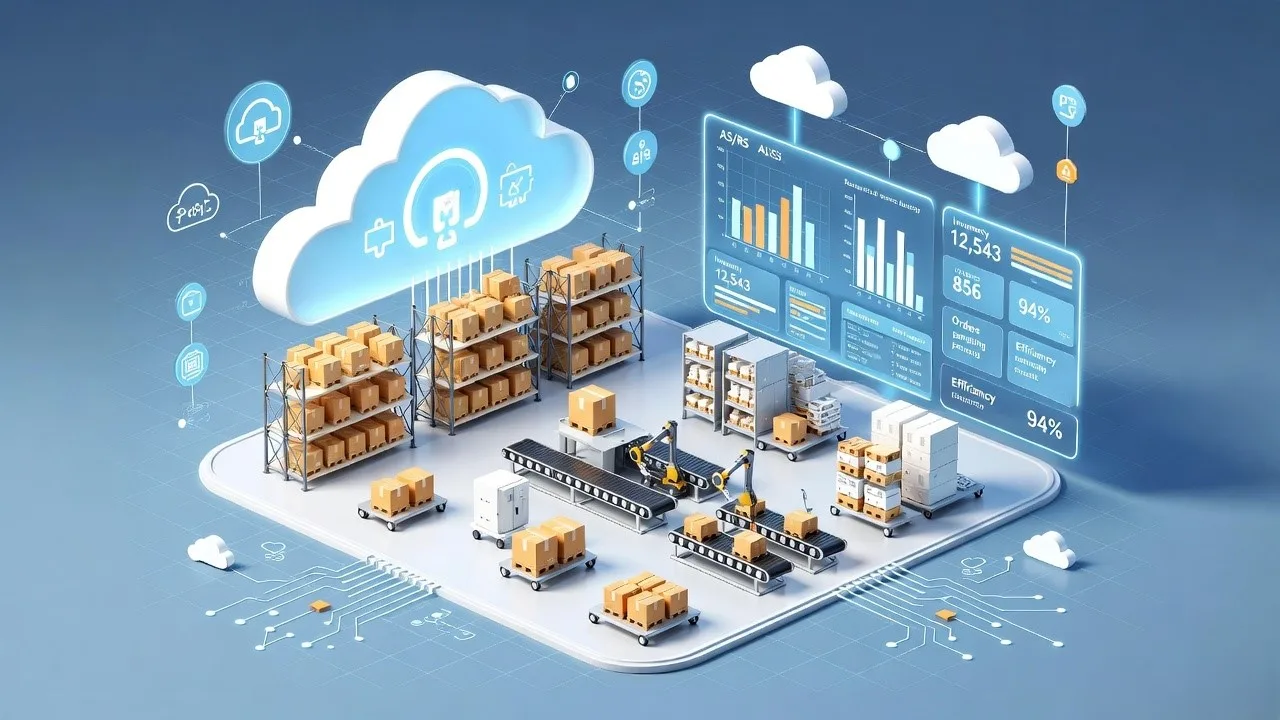
The solution lies in a powerful digital convergence: the merging of Artificial Intelligence (AI) in warehouse automation with flexible, cloud-native SaaS Warehouse Management Systems (WMS).
This is the Intelligent Leap. It transforms the warehouse from a rigid, reactive cost center into a self-optimizing, elastic, and highly profitable fulfillment hub. For businesses seeking a sustainable commercial edge, embracing AI-driven automation governed by a SaaS WMS is not a choice—it is the foundational requirement for resilience and growth.
1. The Power Shift: From Manual Systems to AI Orchestration
Traditional warehouse operations relied on human experience and static WMS rules (e.g., “always restock Bin A when count is 5”). These systems simply cannot handle the speed, complexity, and variability of modern fulfillment.
The Role of Artificial Intelligence in Warehouse Management
Artificial Intelligence in warehouse automation systems provides the cognitive layer that enables dynamic decision-making. AI algorithms constantly process massive streams of data—from conveyor speeds and sensor readings to order queues and labor availability—to make real-time, predictive adjustments.
The two main areas where AI in warehouse automation delivers transformative commercial value are:
- Cognitive Automation: AI drives intelligent decisions within software. This includes Predictive Slotting (forecasting which items should move closer to packing based on anticipated demand), Dynamic Labor Allocation (optimizing worker routes moment-to-moment), and Demand Sensing (adjusting inventory buffers based on social media trends or weather forecasts).
- Physical Automation: AI serves as the brain for physical systems, orchestrating the movements of Autonomous Mobile Robots (AMRs), automated sorting systems, and robotic picking arms, ensuring they operate with seamless traffic control and optimal efficiency.
The SaaS WMS Advantage: Elasticity and Access
The AI layer requires a management system that is equally agile. This is where the SaaS WMS (Software as a Service Warehouse Management System) proves indispensable.
Unlike cumbersome on-premise systems that stifle innovation, a SaaS WMS software solution provides:
- Financial Flexibility: It replaces massive, restrictive Capital Expenditure (CapEx) with a manageable, predictable Operating Expense (OpEx) subscription model, freeing up capital for essential AI and hardware investments.
- Instant Scalability: Being cloud-native, a saas warehouse management system can instantly scale computing power to handle peak e-commerce volume (e.g., Black Friday) without system failure, providing crucial elasticity.
- Continuous Updates: The vendor manages all security patches and feature updates in the cloud, ensuring your system is always running the latest AI-driven optimization algorithms and is ready to integrate the newest generation of robotics.
2. Top AI Warehouse Automation Use Cases for Commercial ROI
The convergence of artificial intelligence warehouse solutions and SaaS WMS delivers massive, measurable ROI across the warehouse floor.
Use Case 1: Predictive Slotting and Dynamic Storage
The placement of inventory directly impacts picking speed and labor costs.
- The AI Solution: The AI system constantly analyzes sales forecasts, historical picking paths, and concurrent order profiles. It predicts which SKUs are likely to be picked together or most frequently and automatically generates dynamic slotting recommendations to move those items to the most accessible locations (golden zone).
- Commercial Benefit: Significant reduction in picker travel time (up to 25%), higher throughput, and minimized costs associated with poor layout.
Use Case 2: Intelligent Task Interleaving and Labor Optimization
Labor costs are the largest variable expense in the warehouse.
- The AI Solution: The WMS Task Agent, powered by AI, dynamically assigns the next optimal task to every worker or AMR based on their real-time location, skill set, and the urgency of the order. It interleaves tasks (e.g., combining a cycle count with a putaway task) to eliminate “empty travel.”
- Commercial Benefit: Increased labor productivity by 20% to 30%, reduction in expensive overtime, and better utilization of human capital.
Use Case 3: Autonomous Mobile Robot (AMR) Orchestration
AMRs are useless without sophisticated traffic control and planning.
- The AI Solution: The AI system manages the entire AMR fleet, controlling traffic flows, assigning tasks (e.g., transferring goods from receiving to storage), and managing battery levels. It dynamically reroutes robots to avoid congestion and prioritizes tasks based on the SaaS WMS order queue.
- Commercial Benefit: Faster, more flexible material handling than traditional fixed conveyors, leading to rapid scaling of fulfillment capacity with minimal infrastructure changes.
Use Case 4: Predictive Maintenance for Automation
Automation equipment is a massive CapEx investment; downtime is catastrophic.
- The AI Solution: IoT sensors on conveyors, robotics, and forklifts feed data (vibration, temperature, power draw) into the artificial intelligence warehouse system. The AI learns the digital signature of an impending failure and predicts when a component will break.
- Commercial Benefit: Maintenance can be scheduled during planned downtime, eliminating catastrophic, unscheduled breakdowns that halt operations. This typically boosts asset uptime by over 25% and extends the lifespan of expensive equipment.
3. The Unified Commercial Advantage
The true commercial power comes from the synergy of the two systems.
Resilience and Adaptability
The SaaS WMS provides the elasticity to handle volume fluctuations, while AI automation provides the intelligence to optimize the physical response to those fluctuations. If a demand spike occurs, the SaaS WMS scales instantly, and the AI immediately adjusts slotting, labor routes, and AMR traffic to meet the surge efficiently without human intervention or system failure.
Financial Audibility and Compliance
Because the SaaS WMS is natively integrated with the financial ERP system, all AI-driven decisions (like inventory transfers or cycle counts) are recorded instantly in the general ledger. This ensures clean data, clear audit trails, and financial compliance, which is often compromised in older, fragmented systems.
Future-Proofing
The combination future-proofs the operation. As new generations of robots or new optimization algorithms emerge, the cloud-based saas wms solutions instantly deploy the necessary software updates and APIs, allowing the warehouse to adopt cutting-edge technology without the pain of large-scale system replacement projects.
In conclusion, the era of relying solely on steel and concrete is over. The future belongs to the agile, intelligent warehouse. By strategically merging AI in warehouse automation with a flexible SaaS WMS, companies gain an unparalleled engine for profitability, resilience, and customer-centric fulfillment, the ultimate foundation for sustained commercial dominance.
People Also Ask
What is the main financial advantage of using SaaS WMS with AI?
It shifts the investment from rigid, expensive CapEx to a flexible OpEx model, freeing up capital for AI and robotics hardware, while ensuring the software is always running the latest, most efficient algorithms.
How does AI improve labor efficiency in the warehouse?
AI uses real-time data to enable Intelligent Task Interleaving. It dynamically assigns the optimal sequence of tasks to workers and AMRs to eliminate “empty travel” and boost labor productivity by up to 30%.
What is Predictive Slotting, and how is it commercially useful?
Predictive Slotting is an AI function that forecasts future demand and dynamically recommends moving high-velocity items to accessible pick faces. This commercially reduces picker travel time and speeds up order fulfillment.
How does the SaaS model help handle peak e-commerce seasons?
The cloud-based SaaS WMS is elastic. It can instantly scale its computing resources to handle massive spikes in order volume (e.g., holidays) without system failure or manual IT intervention.
What role does AI play in warehouse automation maintenance?
AI uses IoT sensor data from equipment to perform Predictive Maintenance. It forecasts when a component is likely to fail, allowing maintenance to be scheduled proactively, preventing catastrophic, costly unplanned downtime.
NunarIQ — The All-in-One AI Agent Platform Driving Efficiency, Precision, and Growth
NunarIQ equips GCC enterprises with AI agents that streamline operations, cut 80% of manual effort, and reclaim more than 80 hours each month, delivering measurable 5× gains in efficiency.
Industries
- Logistics
- Retail
- Manufacturing
- Healthcare
- Finance
- Energy & Resources
Resources
- Blogs
- Whitepaper
- Knowledge Base
- AI Agent Requirement Analysis