
Automated Manufacturing Technology
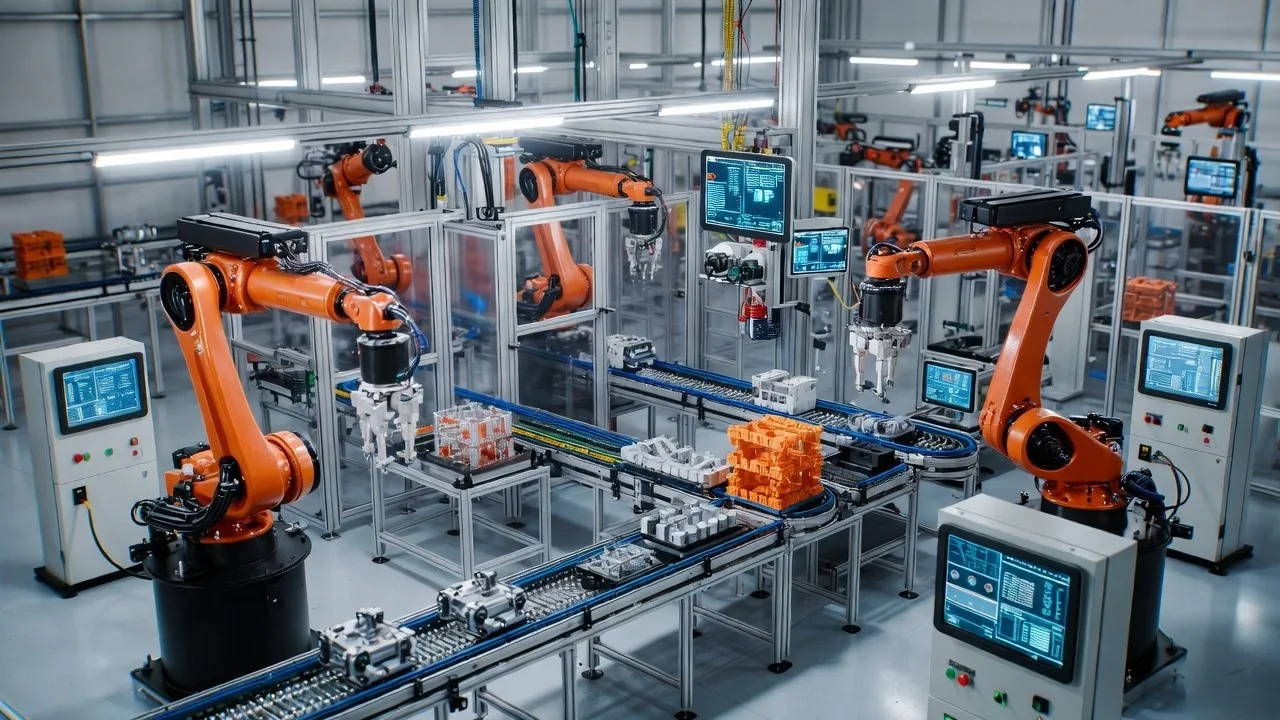
Automated Manufacturing Technology: How AI Agents Are Reshaping US Production
In a factory in the American Midwest, a production line that once required 20 quality control inspectors now needs just two. The difference? An AI agent that scans components with superhuman precision, identifying microscopic defects invisible to the naked eye while simultaneously optimizing material flow. This isn’t a vision of the future, it’s happening today in forward-thinking US manufacturing facilities embracing automated manufacturing technology.
AI agents are advanced software programs that autonomously perform manufacturing tasks, from quality inspection to predictive maintenance, by perceiving their environment, making decisions, and taking action to achieve specific production goals.
📘 Free Guide: “The Future of Automated Manufacturing Technology”
Explore the latest tools, AI agents, and robotics transforming factories today — and learn how to implement them efficiently.
👉 Download the GuideWhat Are AI Agents in Manufacturing?
When we talk about AI agents in manufacturing, we’re not referring to simple automated scripts or rule-based systems. True AI agents are sophisticated software entities that perceive their environment through sensors and data streams, process this information using machine learning and reasoning capabilities, and take autonomous actions to achieve specific manufacturing objectives .
Unlike traditional automation that follows predetermined paths, AI agents adapt to changing conditions. They make judgment calls, learn from outcomes, and optimize processes in real-time without human intervention. At Nunar, we categorize manufacturing AI agents into three capability levels:
- Single-task agents that handle specific functions like visual quality inspection
- Multi-agent systems where coordinated teams of AI collaborate on complex processes
- Cognitive agents that understand context and make strategic decisions
What sets today’s AI agents apart is their ability to break down complex goals into subtasks, plan sequences of actions, and use tools—just as human operators would, but with greater speed, consistency, and analytical depth .
The Critical Role of AI Agents in Modern US Manufacturing
American manufacturers face unprecedented challenges: persistent workforce shortages, global competition, and pressure to reshore production while maintaining cost efficiency. The Manufacturing Institute predicts 1.9 million unfilled manufacturing roles by 2034 , creating an urgent need for technology that amplifies human capabilities.
AI agents have evolved from optional innovations to essential components of competitive manufacturing operations. They’re not merely replacing human labor but augmenting it—handling dangerous, repetitive, or precision-critical tasks while enabling human workers to focus on creative problem-solving, strategy, and exceptions management.
US companies investing in AI-driven automation are seeing tangible results, growing their revenue by 9.6% on average compared to 7.1% among those that took no action on staffing challenges . This performance gap will only widen as early adopters refine their AI implementations and build structural advantages.
Key Automated Manufacturing Technologies Powered by AI Agents
Industrial Internet of Things and Smart Manufacturing
The Industrial Internet of Things forms the central nervous system of modern manufacturing facilities, with connected sensors and devices generating unprecedented data volumes. But data alone isn’t valuable, it’s the AI agents that analyze this information, identify patterns, and take action that creates value .
In US factories implementing IIoT, we’re seeing AI agents that:
- Monitor equipment vibrations, temperatures, and energy consumption in real-time
- Correlate data across multiple systems to identify subtle process inefficiencies
- Automatically adjust parameters to maintain optimal production conditions
- Coordinate between different machines to balance workloads and prevent bottlenecks
One of our automotive manufacturing clients implemented IIoT with specialized AI agents and reduced energy consumption by 14% while increasing throughput by 9% simply because the AI could perceive and respond to micro-inefficiencies that human operators couldn’t detect.
⚙️ Not Sure Which Automation Technology Fits Your Factory?
Our experts can design a custom roadmap to integrate AI-driven manufacturing and robotics in your operations.
👉 Book a Free 20-Minute Strategy SessionEdge Computing and Cloud Computing for Real-Time Processing
The debate between edge and cloud computing in manufacturing has evolved into a strategic partnership between both. Edge computing processes data closer to its source, enabling real-time analysis with low latency, while cloud computing provides scalable analytics, storage, and cross-facility insights .
AI agents leverage this hybrid infrastructure in powerful ways:
At the edge:
- Process high-frequency sensor data with millisecond response times
- Make immediate safety and quality decisions without network dependency
- Continue operating during network interruptions
In the cloud:
- Aggregate data from multiple facilities to identify broader patterns
- Run complex simulations and digital twins
- Provide remote access for experts and management
For example, a food processing plant we work with uses edge-based AI agents to instantly reject substandard products on fast-moving production lines, while cloud-based agents analyze trends across all facilities to predict equipment failures before they occur.
AI-Driven Predictive Maintenance and Quality Control
Traditional maintenance follows fixed schedules or responds to breakdowns. AI-powered predictive maintenance is fundamentally different it analyzes equipment condition in real-time and intervenes precisely when needed. Manufacturers using AI-driven predictive maintenance have reduced downtime by 40%, leading to significant cost savings and improved operational efficiency .
The most advanced implementations we’ve developed use multi-agent systems where:
- Monitoring agents track equipment health indicators
- Analysis agents predict failure probabilities and optimal intervention timing
- Scheduling agents coordinate maintenance windows with production demands
- Parts agents ensure necessary components are available when needed
Similarly, AI-powered quality control has moved beyond simple defect detection to root cause analysis. When an AI agent identifies a quality issue, it doesn’t just flag the problem it traces back through production parameters to identify what caused the deviation and often makes automatic adjustments to prevent recurrence.
Autonomous Robots and Collaborative Robotics
The convergence of AI with robotics is creating a new generation of autonomous systems that can handle increasingly complex tasks. Rather than being limited to repetitive motions, AI-powered robots can adapt to variations in their environment and even collaborate safely with human workers.
In US manufacturing facilities, we’re deploying:
- Autonomous Mobile Robots that navigate dynamic factory environments
- AI-enhanced vision systems that enable robots to handle irregularly positioned items
- Adaptive welding and assembly robots that compensate for part variations
- True collaborative robots that understand human presence and adjust behavior accordingly
The most exciting development is how AI agents enable coordination across multiple robotic systems. In a recent warehouse automation project, our multi-agent system coordinates over 50 autonomous vehicles, optimizing their movements in real-time to eliminate traffic jams and prioritize urgent orders.
Digital Twin Technology for Simulation and Optimization
Digital twins virtual representations of physical objects, systems, or processes have become powerful platforms for AI agents to simulate, analyze, and optimize manufacturing operations without disrupting actual production .
Forward-thinking US manufacturers are using digital twins powered by AI agents to:
- Test new production strategies in simulation before implementation
- Run “what-if” scenarios for process changes or new product introductions
- Train AI systems in realistic virtual environments
- Create continuously updated virtual models that mirror physical operations
One of our most successful digital twin implementations helped an aerospace manufacturer reduce new production line commissioning from 18 months to 7 months by identifying and resolving issues in simulation rather than through physical trial and error.
🚀 Transform Your Factory into a Smart, Automated Operation
Discover how AI agents, robotics, and IoT technologies can increase production efficiency and reduce downtime.
👉 See How It WorksImplementing AI Agents in US Manufacturing Facilities
Assessing Your Readiness for AI Adoption
Not every manufacturing facility is equally prepared for AI implementation. Based on our experience deploying over 500 AI agents, we’ve identified key readiness factors:
Data Infrastructure
- Existing sensor networks and data collection capabilities
- Historical data quality and completeness
- Connectivity throughout the facility
Operational Processes
- Degree of current process standardization
- Willingness to adapt workflows
- Cross-departmental collaboration culture
Technical Capabilities
- IT/OT integration maturity
- In-house technical skills
- Existing automation foundations
Strategic Alignment
- Executive sponsorship
- Clear problem statements
- Measurable success criteria
Manufacturers with strong foundations in these areas typically achieve ROI 3-5 times faster than those addressing multiple gaps during AI implementation.
Overcoming Implementation Challenges
Despite the compelling benefits, AI adoption faces significant hurdles. Understanding these challenges is the first step to overcoming them:
Data Privacy and Security Concerns: AI agents require access to sensitive operational data, raising valid security concerns. Manufacturers must implement robust encryption, access controls, and compliance measures, particularly for facilities handling proprietary processes or regulated products .
Integration with Legacy Systems: Many US manufacturing facilities operate equipment decades old. Retrofitting these systems for AI integration requires specialized expertise. We’ve developed adapter solutions that bridge older equipment with modern AI systems, often using edge computing devices as intermediaries.
Workforce Adaptation: The human dimension of AI implementation is often underestimated. Successful manufacturers invest in change management, reskilling programs, and clear communication about how AI will augment rather than replace human workers.
High Initial Investment: While AI delivers substantial ROI, the upfront costs can be significant. We recommend starting with targeted high-impact applications that demonstrate quick wins and build momentum for broader implementation.
Leading AI Companies Transforming US Manufacturing
Table: Top AI Companies Specializing in Manufacturing Solutions
The Future of AI Agents in US Manufacturing
As AI technology advances, manufacturing applications will become increasingly sophisticated:
Proactive AI Systems: Future AI agents will evolve from reactive tools to proactive partners that anticipate needs and prevent issues before they emerge. These systems will use predictive analytics to recommend optimal production schedules, maintenance windows, and inventory levels .
Hyper-Personalization at Scale: AI will enable mass customization without sacrificing efficiency. Manufacturing lines will automatically reconfigure to produce personalized products, with AI agents managing the complexity of custom orders while maintaining production efficiency .
Self-Optimizing Factories: The ultimate evolution is the fully autonomous factory where AI agents manage end-to-end operations with minimal human intervention. While this vision remains aspirational for most facilities, we’re already seeing elements in advanced facilities where AI agents coordinate across production, maintenance, quality, and logistics.
Expansion of Vertical AI Solutions: The most significant near-term advancement will be the proliferation of industry-specific AI solutions. Unlike generic AI tools, these vertical agents incorporate deep domain knowledge, understand industry-specific terminology, and comply with sector regulations.
Your Path to AI-Driven Manufacturing
The transformation of US manufacturing through AI agents is no longer speculative it’s underway, with measurable results demonstrating significant advantages in efficiency, quality, and resilience. Manufacturers who embrace this technology are building formidable competitive advantages, while those who delay risk falling permanently behind.
The journey begins with specific, high-impact problems rather than wholesale transformation. Identify one or two areas where AI agents could deliver measurable improvements whether in quality control, predictive maintenance, or production optimization and build from there.
At Nunar, we’ve guided dozens of US manufacturers through this transition, from initial assessment to full-scale implementation of customized AI agents. Our experience confirms that the manufacturers achieving the greatest success share common traits: they start with clear objectives, measure results rigorously, invest in both technology and people, and maintain a long-term perspective on continuous improvement.
The future of US manufacturing will be built by those who harness the power of AI agents today. That future is not just automated it’s intelligent, adaptive, and more human-centric than ever before.
People Also Ask
AI agents typically reduce operational costs by 20-30% through optimized resource use, predictive maintenance preventing expensive downtime, and quality control minimizing waste and rework . The specific savings depend on current operational efficiency and the scope of AI implementation.
Traditional automation follows predetermined rules and sequences, while AI agents perceive their environment, make decisions based on real-time conditions, learn from outcomes, and adapt their behavior autonomously without human reprogramming .
Targeted AI applications addressing specific problems can deliver value in 4-8 weeks, while comprehensive multi-agent systems coordinating across departments typically require 6-12 months for full implementation and optimization.