
Table of Contents
Building a Supply Chain Control Tower: A 2025 Guide for US Logistics Leaders
For U.S. logistics managers, the question is no longer if you need a supply chain control tower, but how quickly you can build one that works. I’ve seen the transition firsthand. We used to get daily SAP data dumps for post-mortem analysis, while our competitors were already anticipating disruptions. That gap is what a control tower closes. At Nunar, having developed and deployed over 500 AI agents into production, we’ve moved beyond theory to practical, scalable implementations. This guide breaks down how you can build a control tower that doesn’t just monitor your supply chain, but actively optimizes it.
A supply chain control tower is a centralized, AI-powered platform that provides end-to-end real-time visibility and proactive decision-making for your logistics operations, transforming a reactive supply chain into a resilient, self-optimizing network.
Turn Your Supply Chain Into a Real-Time Intelligence Engine
Let’s craft a control tower tailored for your operations.
💡 Schedule a Strategy CallWhat is a Supply Chain Control Tower?
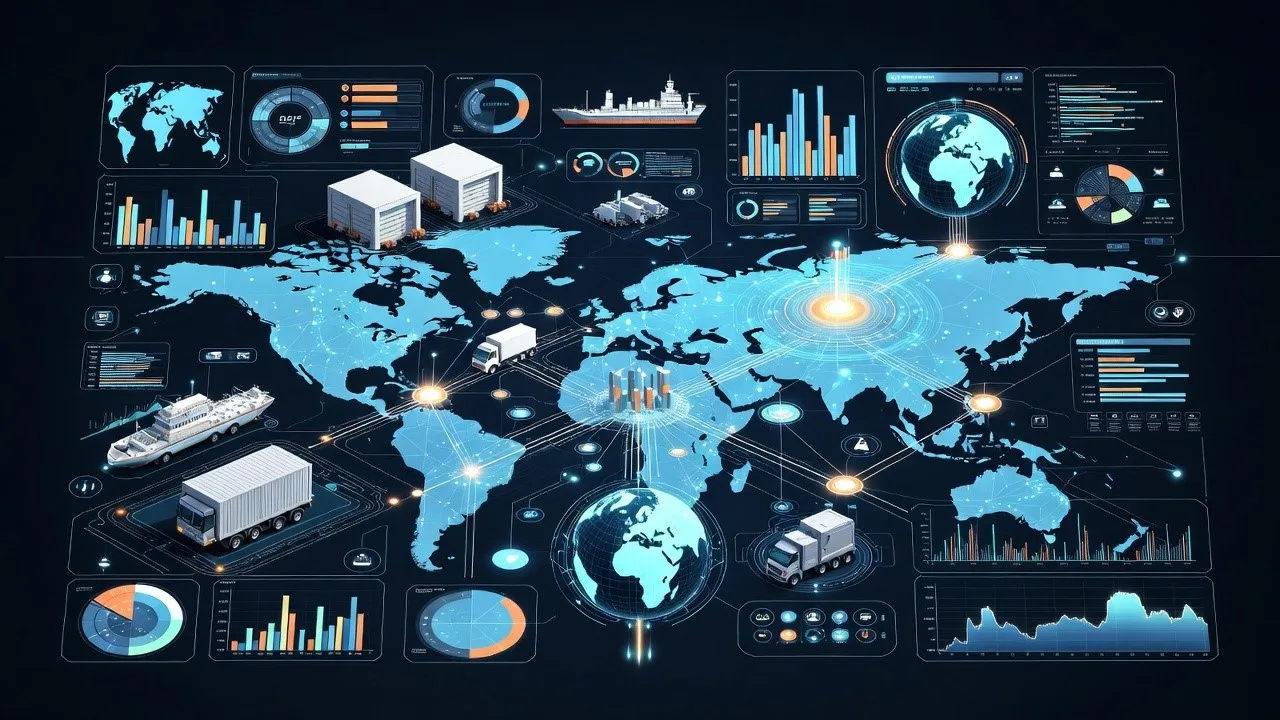
Think of a supply chain control tower not as a single piece of software, but as your logistics command center. Much like an airport control tower sees all activity on the ground and in the air, a supply chain control tower gives you a live, unified view of every trailer, shipment, and dock door across your entire operation .
It’s crucial to understand what a control tower is not. It is not merely a monitoring tool, a replacement for your existing systems like ERP or TMS, or a fully autonomous system that removes human oversight . Instead, it is the connective layer that integrates these systems, turning fragmented data into a single source of truth. For U.S. companies grappling with port congestions, driver shortages, and unpredictable weather, this integrated view is no longer a luxury, it’s a necessity for survival and growth .
The Core Functions of a Modern Control Tower
A well-architected control tower performs several critical functions simultaneously:
- Real-Time Monitoring and Reporting: It tracks shipments, inventory levels, and asset locations, providing live dashboards that replace outdated spreadsheets and manual reports .
- Proactive Exception Management: Instead of you searching for problems, the control tower sends instant alerts for delays, dock backlogs, or equipment failures, allowing your team to act before issues escalate .
- Predictive Analytics and Optimization: By leveraging AI and machine learning, the control tower forecasts potential disruptions, predicts yard congestion, and simulates scenarios like peak season volumes to optimize resources .
- Enhanced Collaboration: It serves as a single platform for your teams, carriers, and warehouse staff to share real-time updates, drastically reducing delays caused by miscommunication .
Why You Need a Control Tower in 2025: The US Context
The business case for control towers has solidified in recent years. For U.S. operations, several converging trends make this technology imperative.
- The Visibility Standard: Real-time visibility is now a baseline expectation from consumers and partners, not a nice-to-have . A 2025 report from Tive underscores this, stating that “supply chain visibility has moved from ‘nice feature’ to ‘survival requirement’” .
- The Rise of AI and IoT: Affordable IoT sensors and mature AI models have made the advanced capabilities of control towers more accessible and powerful than ever . Adoption of IoT shipment tracking grew from 55% to 60% in a single year, and AI for predictive analytics saw a significant jump from 35% to 45% .
- The Capacity and Cost Crunch: With the American Trucking Associations projecting a 160,000-driver shortfall by 2030, the ability to operate efficiently with smooth trailer turnovers and clear dock schedules is a significant competitive edge .
- Regulatory and Sustainability Pressures: New trade rules and mounting pressure to report and reduce carbon emissions make the data-tracking and reporting capabilities of a control tower essential for compliance . In fact, 43% of companies now use visibility technology to reduce fuel consumption .
The impact is tangible. Companies using real-time data have been shown to reduce logistics costs by 15% . In one specific case study cited by Capgemini, dynamic rerouting through a control tower led to up to 30% lower freight costs.
Design Your Smart Supply Chain Control Tower
See how our experts can help you integrate data, dashboards, and alerts seamlessly.
🚀 Request a Live DemoHow to Build Your Supply Chain Control Tower
Building a control tower is a strategic project, not just a software installation. Based on our experience at Nunar, a phased, methodical approach ensures success.
Phase 1: Foundation and Goal Setting
You cannot automate what you do not understand. Begin by mapping your complete as-is supply chain process and identifying specific, measurable pain points. Is it detention fees? Yard congestion? On-time delivery rates? Set clear Key Performance Indicators (KPIs) like reducing detention by 15% or improving yard throughput by 20% . This clarity will guide every subsequent decision.
Phase 2: Technology Selection and AI Agent Integration
This is the core of your build. The platform you choose must be scalable, integrable, and intelligent.
- The Platform Backbone: Select a central software platform that can serve as your single pane of glass. This platform must integrate seamlessly with your existing ERP, TMS, WMS, and YMS .
- The AI Agent Network: This is where the true transformation happens. Instead of building one monolithic “AI,” we architect a network of specialized AI agents, each trained for a specific logistics function. These agents work in concert within your control tower platform. Key agents include:
- Demand Forecasting Agents: These analyze historical sales data, market trends, and even external factors like weather to predict future demand with high accuracy, reducing stockouts and excess inventory .
- Route Optimization Agents: These agents process real-time traffic data, carrier costs, and delivery windows to dynamically determine the most efficient delivery paths, reducing fuel costs and improving on-time delivery .
- Inventory Management Agents: They maintain optimal stock levels across your network by providing real-time updates and automating replenishment signals, which can lead to a significant reduction in carrying costs .
- Predictive Maintenance Agents: For your own fleet and equipment, these agents analyze sensor data to forecast failures before they happen, scheduling maintenance proactively to avoid costly downtime .
Phase 3: Data Integration and System Architecture
A control tower is powered by data. You will need to establish seamless data pipelines from all your core systems (TMS, WMS, ERP) and IoT sensors into your central platform . Data quality is paramount; establish governance protocols to ensure the information your AI agents act upon is accurate and reliable. During this phase, you will also configure the alerts, workflows, and business rules that will automate your response to common events, such as automatically rerouting a trailer if a dock door becomes congested .
Phase 4: Implementation, Training, and Iteration
Adopt a phased rollout, perhaps starting with a single distribution center or a specific logistics lane. This allows you to validate the system, demonstrate quick wins, and build organizational buy-in. Comprehensive training is critical, your team needs to trust and understand the new system. Finally, treat the control tower as a living system. Use its own analytics to continuously monitor performance and refine the AI agent models for ever-improving results .
Control Tower Supply Chain Management Software: Key Features to Look For
When evaluating software providers in the US market, use this checklist to ensure you select a platform that can deliver a true control tower, not just a tracking tool.
- Real-Time Dashboards: Easy-to-understand views of trailer locations, ETAs, yard space, and dock statuses .
- AI-Powered Alerting: Instant, intelligent warnings for late trucks, equipment failures, or potential stockouts .
- Predictive ETAs: The ability to forecast accurate delivery times by analyzing live traffic, weather, and historical carrier performance .
- A Rules and Workflow Engine: The capability to automate actions based on custom business logic (e.g., “if a trailer is delayed by more than 4 hours, automatically reschedule its dock appointment and notify the carrier”) .
- Robust Integration Capabilities: Pre-built connectors for the major ERP, TMS, and WMS platforms common in the U.S. logistics tech stack .
- Collaboration Tools: Built-in features to share updates and communicate with carriers and partners directly within the platform .
The Critical Role of Supply Chain Visibility Control Tower
Visibility is the foundational layer upon which every other control tower capability is built. You cannot optimize what you cannot see. A true visibility control tower moves you from asking “Where are my goods?” to “What might happen to my goods, and how should I respond?” .
This involves a continuous decision-making cycle:
- See: Achieve a live view of all logistics operations.
- Anticipate: Use predictive analytics to forecast potential disruptions.
- Understand: Analyze the business impact of those forecasts.
- Act: Implement corrective or optimization measures.
- Learn: Evaluate outcomes and feed those lessons back into the system to improve future performance .
For U.S. businesses, this level of insight is what allows for proactive management of disruptions, whether they originate from a port strike on the West Coast, a hurricane in the Gulf, or a supplier issue in the Midwest.
People Also Ask
Can small to mid-sized US businesses benefit from a control tower?
Yes. Modern, cloud-based solutions have made control towers affordable and scalable for businesses of all sizes. The key is to start with a specific, high-value pain point rather than attempting a full-scale enterprise rollout on day one
What’s the typical ROI for implementing a control tower?
The ROI can be rapid and significant. Tangible benefits our clients at Nunar have achieved include 10-20% reductions in detention fees, 15% higher yard throughput, and up to 30% lower freight costs from dynamic rerouting
How long does it take to implement a control tower?
Implementation timelines vary, but with modern platforms and a focused scope, you can often see value in a matter of weeks, not years. The key is choosing a solution with a fast implementation track record and avoiding over-customization at the start .
What are the biggest challenges in building a control tower?
The primary hurdles are rarely purely technical. They include integrating with legacy systems, ensuring data quality across partners, managing organizational change, and clearly demonstrating the ROI to secure ongoing investment
NunarIQ — The All-in-One AI Agent Platform Driving Efficiency, Precision, and Growth
NunarIQ equips GCC enterprises with AI agents that streamline operations, cut 80% of manual effort, and reclaim more than 80 hours each month, delivering measurable 5× gains in efficiency.
Industries
- Logistics
- Retail
- Manufacturing
- Healthcare
- Finance
- Energy & Resources
Resources
- Blogs
- Whitepaper
- Knowledge Base
- AI Agent Requirement Analysis