
Computer Vision for Quality Control
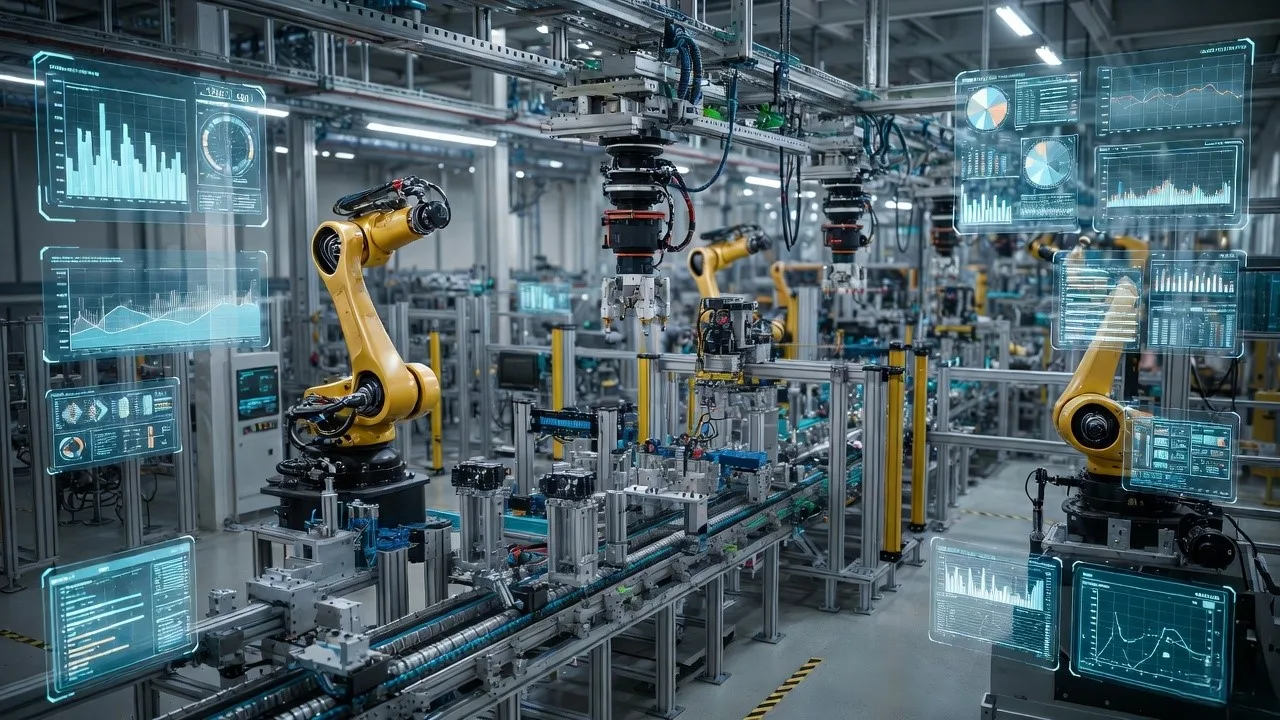
Computer Vision for Quality Control: The 2025 Guide for U.S. Manufacturers
For U.S. manufacturers, the pursuit of perfection on the production line is relentless. Traditional quality inspection, reliant on the human eye, is increasingly a bottleneck, inconsistent, costly, and unable to keep pace with modern volumes and complexities. At Nunar, having developed and deployed over 500 AI agents into production, we’ve seen a consistent trend: computer vision is no longer a future concept but a present-day imperative for maintaining a competitive edge.
This guide cuts through the hype to provide a clear, actionable understanding of how AI-powered visual intelligence is transforming quality control from a cost center into a strategic asset.
Computer vision for quality control uses AI-powered cameras and deep learning algorithms to automatically and consistently inspect products for defects, ensuring higher quality, reducing costs, and improving operational efficiency in manufacturing.
What is Computer Vision in Manufacturing Quality Control?
Computer vision is a field of artificial intelligence that enables machines to interpret and understand the visual world. By simulating human sight, computer vision allows systems to recognize and analyze images, videos, and other visual inputs, transforming them into actionable information.
In the context of quality control, this technology moves beyond manual inspection. It involves installing cameras and sensors at critical points on the production line. These systems capture visual data, which is then processed by deep learning models—often convolutional neural networks (CNNs), to perform tasks like anomaly detection, classification, and object detection with superhuman speed and accuracy.
The core value lies in its consistency. While a human inspector might be affected by fatigue, distraction, or subjective judgment, a computer vision system provides an objective, repeatable, and scalable standard for quality inspection 24/7. This is not about replacing human workers, but about augmenting their capabilities and freeing them to focus on more complex, value-added tasks.
Key Benefits of Computer Vision for Quality Control
The shift from manual to AI-driven inspection delivers tangible, bottom-line results for U.S. factories and plants.
- Unprecedented Defect Detection Accuracy: Manual inspection is prone to human error, especially in high-volume environments. Computer vision systems offer a consistent and objective standard. Studies and real-world applications show that AI-powered quality inspection can improve defect detection rates by up to 90%. This drastic reduction in escape rates protects your brand reputation and minimizes costly recalls.
- Significant Cost Reduction: Catching a defect early in the production process is exponentially cheaper than discovering it after it has reached a customer. Automated inspection slashes costs associated with rework, waste, returns, and warranty claims. McKinsey findings indicate that AI-powered quality inspection can cut costs by as much as 50%.
- Enhanced Operational Efficiency: Computer vision systems can inspect products at the full speed of your production line, eliminating the bottleneck of manual checks. This leads to higher throughput and better overall equipment effectiveness (OEE). The technology also enables predictive maintenance, where cameras monitor equipment for subtle wear or misalignment, allowing for scheduled maintenance before a failure causes unplanned downtime.
- Improved Worker Safety and Focus: By automating repetitive and sometimes hazardous inspection tasks, computer vision reduces the need for workers to be in close proximity to fast-moving machinery. It can also monitor the production floor to ensure compliance with safety protocols, such as verifying the use of personal protective equipment (PPE) like helmets and gloves.
How Computer Vision is Applied in Manufacturing Quality Control
The applications for computer vision in quality control are vast and tailored to specific manufacturing needs. Based on our deployments, here are the most impactful use cases.
1. Surface and Defect Detection
This is the most common application. AI models are trained to identify imperfections that might be invisible or difficult for the human eye to spot consistently.
- What it solves: Detecting micro-cracks, scratches, dents, color inconsistencies, and coating defects on products ranging from automotive panels to smartphone casings.
- Real-world example: In aerospace manufacturing, computer vision systems inspect carbon fiber reinforced polymer tape layers for critical defects such as gaps or overlaps with extreme precision.
2. Assembly Verification
Ensuring that a product has been put together correctly before it moves to the next stage is crucial.
- What it solves: Verifying the presence, placement, and orientation of all components. This prevents incomplete products from shipping and avoids downstream assembly issues.
- Real-world example: A system can confirm that every connector is snapped into place on an electronic control unit or that all labels are correctly applied to a consumer goods package.
3. Measurement and Gauging
Computer vision provides non-contact, high-speed measurement of critical dimensions.
- What it solves: Accurately measuring the size, diameter, or volume of components to ensure they are within specified tolerances. This is essential in industries like medical device manufacturing where precision is paramount.
- Real-world example: A vision system can measure the gap between a car door and its frame to ensure a perfect fit and finish on the assembly line.
4. Code Reading and Traceability
Nearly every manufactured item has a barcode, QR code, or serial number for tracking.
- What it solves: Automatically reading and verifying these codes, even if they are damaged, poorly printed, or applied to a curved surface. This ensures full traceability throughout the supply chain.
- Real-world example: A Fortune 100 technology company optimized logistics across 400+ global warehouses with a computer vision solution for automated package tracking, ensuring real-time monitoring even with challenging label visibility.
A Comparison of Computer Vision Approaches for Quality Control
Implementing Computer Vision in Your U.S. Manufacturing Facility
A successful deployment is more than just buying the right camera. It requires a strategic approach tailored to your specific operational environment.
Step 1: Define the Problem and Scope
Start with a clear, narrow focus. Identify a specific, high-value quality issue, for instance, “reduce scratch-related returns on Product X by 75%.” A well-defined problem is easier to solve and demonstrates clear ROI, paving the way for broader adoption.
Step 2: Data Collection and Preparation
AI models learn from data. You will need to collect thousands of images of both “good” and “defective” products under consistent lighting and angles. This is often the most time-consuming phase, but tools like Roboflow can streamline the process of organizing, labeling, and augmenting your image datasets.
Step 3: Model Selection and Training
For most modern quality control tasks, deep learning is the preferred approach. You can use pre-trained models from platforms like Google’s Vertex AI or Microsoft Azure AI and fine-tune them with your data, or build a custom model from scratch. The choice depends on the uniqueness of your defect and the volume of data available.
Step 4: Deployment and Integration
This is where the AI agent meets the physical world. The trained model must be deployed where the inspection happens—often directly on the factory floor. This can be done via edge computing devices for low-latency, real-time analysis without relying on a cloud connection. The system must be integrated with your production line controls to automatically accept or reject items.
Step 5: Continuous Monitoring and Improvement
A deployed model is not a “set it and forget it” solution. You must monitor its performance to detect “model drift,” where its accuracy decreases over time as product variations or lighting conditions slowly change. At Nunar, our AI agents are designed for continuous learning, allowing them to adapt and improve based on new data without full retraining.
Top Computer Vision Companies and Platforms for U.S. Manufacturers
The ecosystem of providers is diverse, ranging from established industrial automation giants to agile AI specialists.
- Industrial Leaders: Companies like Cognex Corporation and Basler AG have deep expertise in traditional machine vision and are increasingly incorporating AI into their hardware and software offerings.
- Cloud AI Platforms: Google Cloud Vision AI, Amazon SageMaker, and Microsoft Azure AI offer powerful, scalable APIs and custom model training tools. These are excellent for companies already invested in a specific cloud ecosystem.
- End-to-End Platforms: Roboflow is a popular platform that simplifies the entire computer vision pipeline, from dataset management and labeling to model deployment, making it accessible even for teams with limited ML expertise.
- Specialized AI Agent Developers (like Nunar): For manufacturers seeking a fully custom, turnkey solution, specialized AI development companies focus on building and deploying intelligent agents that are deeply integrated into your specific manufacturing workflows and business systems.
The Future of Quality Control is Visual
Computer vision has fundamentally shifted the paradigm of quality control in U.S. manufacturing. It is no longer a question of if but when and how to integrate this transformative technology. The journey begins with a single, well-defined problem. The success you achieve there creates the momentum for plant-wide digital transformation.
The future is moving towards Visual General Intelligence (VGI), where systems will not only detect known defects but also understand context, reason about new anomalies, and interact with the production environment in increasingly human-like ways. The competitive advantage will belong to those who harness this visual intelligence today.
At Nunar, we specialize in building and deploying practical AI agents that solve real manufacturing problems. With over 500 successful deployments, we have the experience to guide your quality control transformation. Contact our team today for a free, personalized assessment of your highest-value quality inspection opportunity.
People Also Ask
Costs vary widely based on complexity, ranging from a few thousand dollars for a simple, off-the-shelf application to several hundred thousand for a fully custom, multi-point inspection system; the key is that ROI is often achieved through massive reductions in scrap and rework.
In controlled tasks, computer vision consistently outperforms human inspection in both speed and accuracy, with some systems achieving over 99% detection rates on trained defects, operating 24/7 without fatigue
Yes, modern deep learning systems, especially those described as “self-learning,” can be retrained or fine-tuned with new image data to adapt to product changes, significantly reducing reprogramming downtime compared to traditional rule-based systems.
In a manufacturing context, the primary concern is securing the visual data collected; this is typically addressed through on-premise (edge) deployment, which keeps data within the factory and avoids cloud privacy issues