Table of Contents
From Wiring Diagrams to Neural Networks: Redefining Factory Automation System Integration
The US Industrial Automation System Integrator Market is a massive, complex landscape, valued at an estimated $30 billion in 2024 and projected to grow rapidly toward $45 billion by 2035, according to recent market analysis. This immense growth is driven by a singular, urgent need: American manufacturers must automate their operations to compete globally, counter crippling labor shortages, and ensure supply chain resilience.
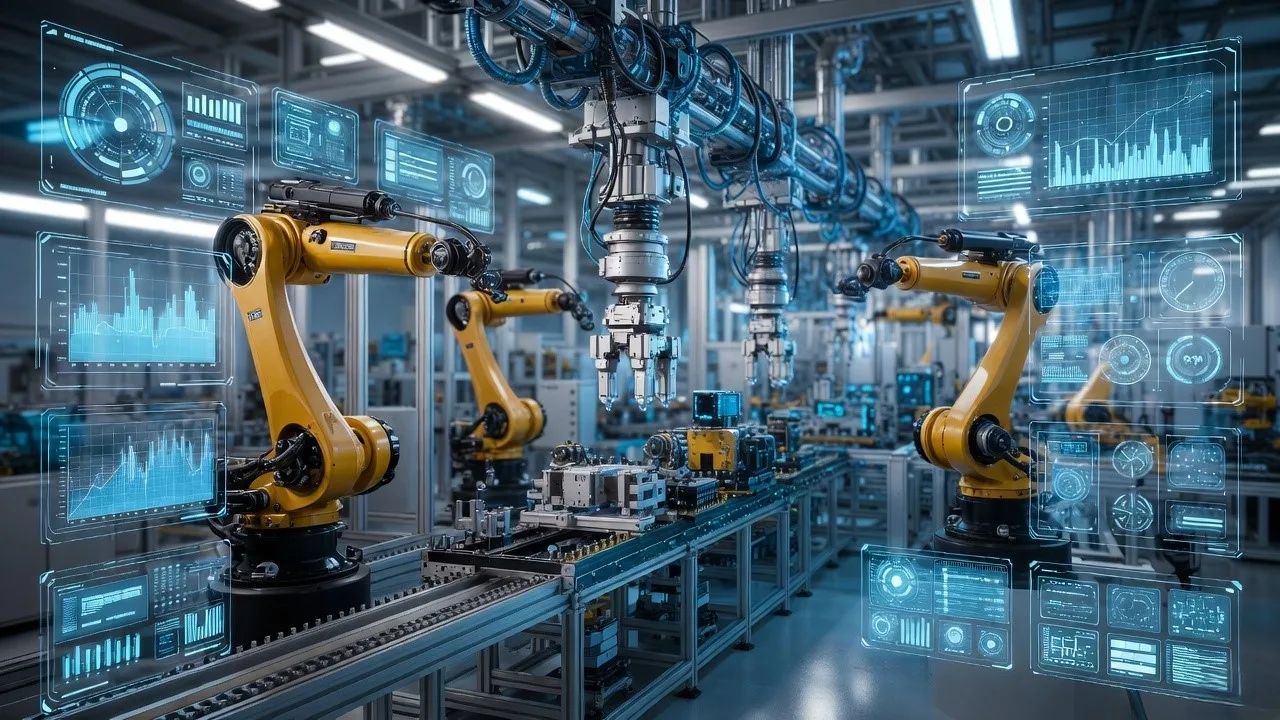
However, the traditional factory automation system integrator—focused primarily on physical hardware (robotics, PLCs, conveyor belts) and hard-coded logic—is reaching its operational limit. The speed and adaptability required by modern digital manufacturing simply outpace fixed programming.
At Nunar, we don’t just integrate systems; we infuse them with intelligence. As an AI agent development company for manufacturing, I have personally overseen the deployment of over 500 autonomous AI agents in production across various U.S. sectors, from automotive in the Midwest to advanced materials in California. My experience as a product strategist confirms that the integrator’s role has fundamentally shifted from a wiring specialist to a cognitive architect.
This deep dive is for U.S. manufacturing executives—plant managers, CTOs, and heads of operations—who are facing the inevitable decision to upgrade. We will detail how to vet the new generation of integrators, overcome major legacy system roadblocks, secure your IT/OT convergence, and, critically, how to calculate the true ROI of an AI-enhanced automation project.
The next-generation factory automation system integrator must move beyond hard-coded logic to deploy autonomous AI agents that ensure real-time optimization, resilience, and immediate ROI.
The Shift from Traditional to AI-Centric System Integrators
The fundamental difference between a traditional integrator and an AI-centric one is the core focus: physical automation versus cognitive automation.
The Limitations of the Traditional Approach
Traditional factory automation system integrators excel at two things: installing hardware and programming sequential logic. They install a robot (e.g., a Fanuc or KUKA arm) and program a specific sequence of actions using ladder logic (LAD) in a Programmable Logic Controller (PLC) like Rockwell Automation’s ControlLogix.
- Fixed Logic, Fragile Performance: If a variable changes (e.g., material quality, ambient temperature, tooling wear), the hard-coded logic fails. The machine stops, or it produces scrap.
- Reactive Maintenance: Their model relies on human inspection or scheduled maintenance. They can install sensors (IIoT), but they lack the ability to write algorithms that truly interpret the subtle, early signals of failure.
- Time-to-Value: Custom programming for every minor change takes weeks, creating an “innovation bottleneck.”
The Cognitive Advantage: Nunar’s AI Agents
The AI-centric integrator, like Nunar, still manages the hardware installation, but our product engineering services are centered on deploying and training AI agents that give the hardware cognitive function.
- Adaptive Control: Instead of a fixed loop, our Process Optimization Agent learns the optimal machine parameters for any material batch or environmental condition, adjusting feed rates or temperatures in milliseconds.
- Predictive Autonomy: Our Predictive Maintenance Agent analyzes high-frequency vibration, thermal, and current data to predict when a component will fail (not just if it is failing), allowing for just-in-time, non-disruptive maintenance.
- Fleet Learning: The intelligence gained by one agent (e.g., how to compensate for humidity in a painting booth) is immediately and securely transferred to all other similar machines across the factory or enterprise, a core benefit we emphasize for our U.S. manufacturers.
Interoperability and Legacy System Challenges in U.S. Factories
The single greatest hurdle to modern automation is not technology; it’s the legacy infrastructure prevalent across older U.S. Manufacturing sites.
Bridging the IT/OT Divide
Most American factories operate with decades-old Operational Technology (OT) that includes proprietary protocols (like Modbus, PROFINET, or EtherNet/IP) and control systems (SCADA, DCS, standalone PLCs). This equipment was never designed to securely communicate with modern Information Technology (IT) systems like cloud databases, ERPs (e.g., SAP), or advanced analytics platforms.
- Data Silos: Production data (what happened) remains stuck in the OT layer, while business data (what should happen) is in the IT layer. This prevents a holistic view of the operation.
- Fragmentation: Attempting to force communication often involves complex, brittle middleware, which becomes the primary point of failure.
Nunar’s Abstraction Layer Solution
Our solution, which we deliver as part of our core product engineering services, focuses on building a robust data abstraction layer at the Edge. We utilize lightweight, universal message protocols like MQTT to standardize data transfer.
- Decoupling Logic: Our AI agents run on secure, low-latency industrial edge devices (e.g., platforms from AWS IoT Greengrass or Azure IoT Edge) separate from the core PLC logic. The agent is the interpreter and optimizer, sending only the final, necessary control command back to the legacy PLC.
- Protocol Agnostic Design: This allows us to rapidly deploy the same Generative AI Chatbots or monitoring agents onto a diverse fleet of machines—from a 1990s vintage machine tool to a brand-new collaborative robot—solving the long-standing challenge of Interoperability and Legacy System Challenges in U.S. Factories.
Industry Example: A major food & beverage client in Texas had a mix of legacy Honeywell DCS and newer Siemens PLCs controlling their batch processes. A traditional integrator quoted six months and a complete overhaul. Nunar’s team integrated a unified Process Oversight Agent in less than four weeks by using the abstraction layer to harmonize data feeds, achieving a 15% reduction in batch-to-batch variation in the first quarter.
Calculating the ROI of AI-Enhanced Automation Projects
For U.S. manufacturing executives, the cost of automation is high, but the cost of not automating is often higher. When selecting a factory automation system integrator, the calculation of Return on Investment (ROI) must reflect the value of cognitive capabilities, not just physical speed. This is the new framework for Calculating the ROI of AI-Enhanced Automation Projects.
Beyond Labor Reduction: Efficiency and Throughput
Traditional ROI focuses on labor cost savings. The AI-centric approach focuses on maximizing asset utilization and quality assurance.
| ROI Metric (Traditional SI) | ROI Metric (AI-Centric SI – Nunar) | Expected Impact |
| Labor Cost Savings | Downtime Avoidance Value (DAV) | Avoids costs associated with up to 40% of unscheduled maintenance. |
| Increased Cycle Speed | OEE Improvement (AI-Optimized) | Drives up Overall Equipment Effectiveness (OEE) by reducing variability and micro-stoppages. |
| CAPEX on New Hardware | OPEX on Agent Subscription | Shifts cost from large upfront capital expenditure to predictable, scalable operating expense. |
| Warranties/Service Contracts | Scrap/Rework Reduction Value | AI Vision Agents cut Defect Per Million Opportunities (DPMO) by identifying flaws human eyes miss. |
- Downtime Avoidance Value (DAV): This is the core financial driver. For a large US automotive plant, unplanned downtime can cost upwards of $50,000 per hour (source: Deloitte analysis). By avoiding just one major four-hour failure annually per critical machine, the Predictive Maintenance Agent pays for itself several times over.
- Scrap Reduction: Our AI Quality Agent uses computer vision and deep learning to perform 100% inline inspection, not random sampling. This results in significant material and energy savings, a critical factor for energy-intensive US manufacturers in states like Ohio or Pennsylvania.
Scalability and Payback Period
A core part of our Product Engineering Services is to design for scale. A successful pilot project should be immediately transferable.
- Modular Agent Architecture: Nunar designs its agents to be modular. Once a solution is proven on one machine, it can be deployed on the next 100 with minimal engineering time. This dramatically reduces the marginal cost of expansion and accelerates the enterprise-wide ROI, delivering significant financial benefits to US-based manufacturers.
- 12-18 Month Payback Target: We aim for and typically achieve a 12-to-18-month payback period for our initial AI agent deployments, which quickly justifies the ongoing OPEX required for the solution.
Selecting the Right Factory Automation System Integrator Checklist
Choosing an integrator is a strategic decision that determines your factory’s competitive edge for the next decade. Do not select a partner based on who can deliver the cheapest hardware. Use this Selecting the Right Factory Automation System Integrator Checklist focused on the future of intelligent automation.
The Six Core Assessment Criteria:
- OT/IT Fluency: Do they have dedicated teams that understand both PLC/SCADA programming AND Python/TensorFlow/Cloud architecture? If they outsource the AI component, they are not an AI-centric integrator.
- Nunar Advantage: Our team of engineers and product strategists is structured to manage the full IT/OT convergence, allowing us to build reliable, high-performing Web App Development interfaces for monitoring and control.
- E-E-A-T and Scale: Do they have provable, deployed AI agents in production?
- Nunar Advantage: We can demonstrate our 500+ AI agents deployed in production, which is the authority and experience you need to trust. Ask for specific case studies in your industry.
- Data Strategy First: Do they lead with a data architecture plan before they talk about hardware? The first step should be defining the Digital Thread—the flow of data from the sensor to the ERP.
- Cybersecurity Compliance: Are they familiar with NIST SP 1800-10: Cybersecurity for the Manufacturing Sector? Integration of IT and OT networks exponentially increases risk. A modern integrator must build security into the design, not just bolt it on.
- Agent Governance and Ownership: Who owns the IP of the AI models trained on your data? A true partner ensures the client retains ownership of the learned models, ensuring long-term control and strategic value.
- Change Management Plan: How will they train your existing workforce? The best technology fails if operators don’t trust it. A strong integrator will have a detailed plan to transform operator roles into high-level system supervisors.
Securing the Smart Factory: Cybersecurity in Automation Integration
As a strategic AI partner for manufacturers, we recognize that our agents, while providing immense value, also increase network connectivity. For US manufacturers, where IP and operational stability are national security concerns, Securing the Smart Factory: Cybersecurity in Automation Integration is non-negotiable.
Adherence to NIST Standards
Any integrator working in the United States must operate within the framework set by the National Institute of Standards and Technology (NIST), particularly the NIST Cybersecurity Framework and SP 1800-10.
- Zero-Trust Architecture: Every new device added to the factory floor (IIoT sensor, Edge server, or robot controller) must be treated as hostile until verified. Our design philosophy implements micro-segmentation, isolating critical OT control systems from the broader IT network.
- Secure Device Onboarding: The integrator must have a policy for managing the “Software Bill of Materials” (SBOM) for all integrated devices. We ensure all third-party components (e.g., controllers or network switches) are procured with verifiable security and secure update capabilities, mitigating the risk of supply chain attacks.
- Agent Identity Management: Each of our Generative AI Chatbots and operational agents has a unique, secure identity that requires constant re-authentication. This prevents a compromised agent from gaining unauthorized access to critical PLCs.
The Risk of Unsecured Web App Development (H3)
When an integrator builds a custom HMI or dashboard for monitoring, they are building a web application. If this web app development is not hardened against common vulnerabilities (like SQL injection or XSS), it becomes the easiest back door into the OT network. This is why our development process includes continuous security testing, adhering to the highest standards for web app development company practices, even in an industrial setting.
The Agentic Approach to Real-Time Process Optimization
The key to unlocking peak efficiency lies in the Agentic Approach to Real-Time Process Optimization. This is where multiple, specialized AI agents collaborate autonomously to manage a complex manufacturing process.
Collaboration and Collective Intelligence
Consider a typical stamping line in an American automotive factory. Instead of one monolithic program, an Agentic AI Mesh involves:
- The Scheduling Agent (Planning): Communicates with the ERP/MES to understand the production goal (e.g., 500 units by 3 PM) and current inventory. It adjusts the start time and sequence of upstream machines.
- The Process Agent (Execution): Monitors the stamping force, material temperature, and lubrication flow. If the incoming steel is slightly harder, it communicates with the Temperature Agent and the Predictive Maintenance Agent to verify that the adjusted force won’t compromise the press or a motor bearing.
- The Quality Agent (Verification): Inspects the finished stamp using computer vision. If a micro-fracture is detected, it immediately sends feedback to the Process Agent to adjust its parameters for the next unit, resulting in continuous, closed-loop correction.
This real-time, adaptive intelligence is what separates an automated factory from an autonomous factory. It allows U.S. manufacturing to handle high-mix production runs with maximum efficiency, making onshoring and customized production economically viable.
AI Agents in System Integration: Traditional vs. Cognitive
When evaluating factory automation system integrators, focus on their core competency. This comparison illustrates the dramatic difference in project focus and delivered value.
| Metric / Service | Traditional System Integrator | AI-Centric System Integrator (Nunar) |
| Core Focus | Connecting hardware (PLCs, robots) and writing fixed logic. | Infusing intelligence (AI agents) to manage hardware and optimize processes. |
| Time-to-Value | Slow; requires long commissioning time for physical logic validation. | Fast; AI agents can learn optimal parameters within weeks of deployment. |
| Key Deliverable | HMI Screens, PLC Code, As-Built Drawings. | Generative AI Chatbots for diagnostics, Process Optimization Agents, Predictive Models. |
| Data Strategy | Point-to-point connections; Data remains in silos (OT). | Enterprise-wide abstraction layer; Data fed to Cloud/MES for deep analytics. |
| Risk Mitigation | Manual backups, physical safety guards. | AI-driven safety agents (predictive crash avoidance), NIST-aligned cyber security. |
| Flexibility | Low; high cost for re-programming for new products/materials. | High; AI models adapt autonomously to new product specs and materials. |
People Also Ask
How do I calculate the real ROI of an AI-enhanced automation project versus a traditional one?
The real ROI is calculated by focusing on the value of avoided costs, primarily Downtime Avoidance Value (DAV) and Scrap/Rework Reduction, rather than just basic labor savings or marginal speed increases.
What are the main risks associated with integrating AI agents into existing factory automation systems?
The main risks involve data security and quality, specifically the potential for fragmented or biased training data to lead to poor decisions, as well as the amplified cybersecurity risk resulting from connecting operational technology (OT) to the IT network.
What role does a Generative AI Chatbot play in factory automation integration?
A Generative AI Chatbot acts as an intelligent, natural language interface for system diagnostics, allowing operators and maintenance staff to query the system for real-time fault analysis, maintenance procedures, and historical performance insights without navigating complex HMI menus.
What security standards should a system integrator adhere to in the US for smart factories?
A competent integrator should adhere to the standards outlined by the National Institute of Standards and Technology (NIST), specifically utilizing the NIST Cybersecurity Framework and applying controls from NIST SP 1800-10 for securing the IT/OT convergence.
NunarIQ — The All-in-One AI Agent Platform Driving Efficiency, Precision, and Growth
NunarIQ equips GCC enterprises with AI agents that streamline operations, cut 80% of manual effort, and reclaim more than 80 hours each month, delivering measurable 5× gains in efficiency.
Industries
- Logistics
- Retail
- Manufacturing
- Healthcare
- Finance
- Energy & Resources
Resources
- Blogs
- Whitepaper
- Knowledge Base
- AI Agent Requirement Analysis