
Table of Contents
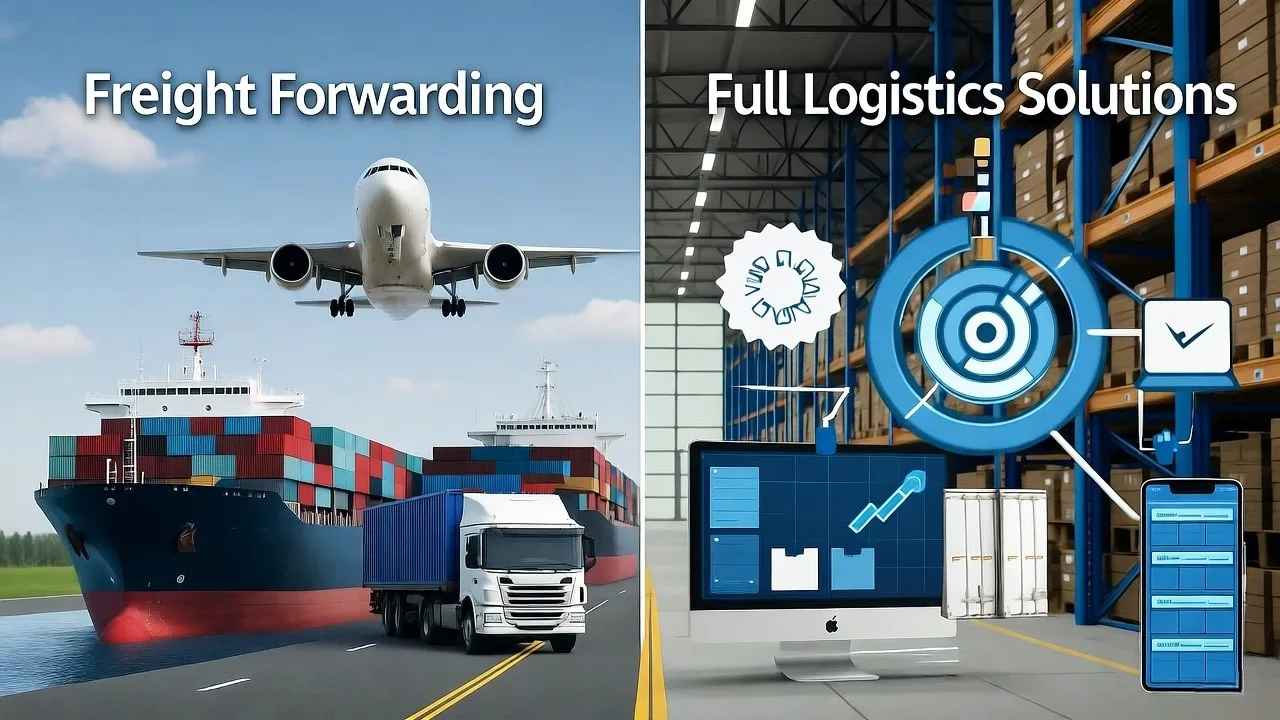
Freight Forwarding vs Full Logistics Solutions – A Comparison Guide
When we evaluate a client’s supply chain architecture, especially in the competitive US logistics and supply chain environment, the distinction between a freight forwarder and a 3PL (full logistics provider) is the starting point. It’s a difference in scope, asset ownership, and overall partnership model.
Freight Forwarding: The Master Orchestration of Movement
A freight forwarding company is, fundamentally, an asset-light middleman. Their core value proposition is leveraging an extensive network of carriers (ocean, air, rail, and road) to book space and manage the complex administrative processes required to move goods from point A to B.
- Core Focus: Transportation arrangement and documentation.
- Key Services: Booking cargo space, negotiating rates with carriers, freight consolidation, and managing customs brokerage and paperwork (e.g., Bills of Lading, commercial invoices).
- Asset Profile: Non-asset-based. They do not typically own the ships, planes, or trucks (though some larger firms are hybrid).
- Typical US Client: Businesses with strong in-house warehousing and inventory management, but who need expert assistance with complex international shipping or managing intermodal freight in North America.
Full Logistics Solutions (3PL/4PL): The End-to-End Supply Chain Partner
A full logistics solution, or 3PL (Third-Party Logistics), takes on a significantly broader mandate. They manage an entire functional segment, or even the whole, of your supply chain. They are a true operational partner, often integrating directly into your ERP and WMS systems.
- Core Focus: End-to-end supply chain management, execution, and optimization.
- Key Services: Transportation management, warehousing and distribution, inventory management, order fulfillment, packaging, and reverse logistics.
- Asset Profile: Often asset-heavy (owning warehouses, trucks, or equipment) or hybrid, allowing them greater control over execution.
- Typical US Client: E-commerce firms requiring scalable e-commerce fulfillment in the US, growing manufacturers, or businesses looking to entirely outsource their supply chain operations to focus on core product/service development.
Choosing Your Partner: Freight Forwarding vs. Full Logistics for US E-commerce and Manufacturing
The choice is not about which service is “better”, it’s about which service aligns with your business maturity, risk profile, and strategic objectives for your US freight management strategy.
When a Freight Forwarder is the Right Move
If your business is focused purely on international freight forwarding and you already have your North American warehousing and distribution figured out, a forwarder is ideal.
- Cost Efficiency for International Trade: They secure better rates by consolidating smaller shipments (LCL/LTL) into full-container loads (FCL), a critical function for US importers and exporters navigating the ocean freight shipping market.
- Expert Customs Navigation: For a US company shipping to or from high-volume ports like Los Angeles/Long Beach, Houston, or Newark, the expertise in US customs brokerage is invaluable for ensuring compliance and minimizing delays. This is especially true given recent trade policy shifts impacting US imports (DataM Intelligence).
- Simpler Vendor Management: You deal with one party for transportation, who then handles coordination across multiple carriers, simplifying your vendor landscape.
When a Full Logistics (3PL) Solution is Essential
If your goal is to dramatically scale your fulfillment, reduce capital expenditure on non-core assets, or increase your supply chain visibility, a 3PL is the necessary strategic partner.
- End-to-End E-commerce Fulfillment: For a US e-commerce business, a 3PL like Amazon Logistics or GXO Logistics handles everything from receiving inventory to picking, packing, and last-mile delivery. They are the engine of your direct-to-consumer (D2C) operation.
- Scalable Infrastructure (Warehousing): A 3PL provides access to a national network of warehouses, which is vital for reducing last-mile costs and delivery times in the US. They allow you to instantly scale inventory without buying or leasing commercial real estate.
- System Integration and Optimization: The best 3PLs offer comprehensive Transportation Management Systems (TMS) and Warehouse Management Systems (WMS), giving US businesses real-time visibility and powerful optimization tools, often powered by AI and automation (we’ll dive into this shortly).
The AI-Driven Advantage: Optimizing US Supply Chains with Autonomous Agents
This is where the distinction between traditional logistics and a future-proof, technology-first approach becomes critical. Simply moving freight is a commodity; optimizing the entire flow is a source of competitive advantage. At Nunar, we don’t just see a load of cargo; we see a cascade of data points waiting to be orchestrated by a new class of sophisticated software: the AI Agent.
The future of both freight forwarding and full logistics in the US market, from the docks of Charleston to the inter-modal hubs of Chicago, will be defined by the adoption of these intelligent, goal-oriented systems. Our work developing over 500 such agents and deploying them in production has revealed a new operational playbook for US supply chain leaders.
Autonomous Agents in Freight Forwarding: The Predictive Intermediary
An AI Agent deployed at a freight forwarder transforms the role from a human intermediary to a Predictive Inter-modal Logistics Planner.
- Dynamic Route & Rate Negotiation: Our AI agents monitor global and domestic spot market rates for road freight, air freight forwarding, and ocean routes in real-time. They don’t just get a quote; they predict the future optimal route based on geopolitical risk, weather patterns, and port congestion at key US hubs like the Port of Savannah, automatically locking in capacity when the price-risk ratio is best.
- Automated Customs and Compliance: Up to 80% of manual paperwork related to customs brokerage can be eliminated. Our agents ingest ever-changing US tariff codes and compliance documentation, autonomously preparing and filing necessary paperwork, dramatically reducing human error and expediting border crossings.
- Capacity Aggregation: Digital freight marketplaces now aggregate SME demand and auction it to carriers, cutting freight spend by over 10% (Mordor Intelligence). AI agents take this a step further by autonomously identifying the optimal consolidation strategy for your cargo based on other available freight in the network, maximizing the value of multimodal logistics in the United States.
Autonomous Agents in Full Logistics: The Self-Optimizing Supply Chain
In a 3PL environment, AI agents evolve from simply managing tasks to running entire operational loops autonomously, creating a truly self-healing supply chain.
| AI Agent Type | Function in Full Logistics (3PL) | US Business Benefit |
| Inventory Optimization Agent | Predicts micro-demand spikes using sales data and social sentiment. Autonomously rebalances inventory across a national warehouse network (e.g., between a Dallas and a New Jersey fulfillment center) to prevent stockouts and overstocking. | Reduces capital tied up in excess inventory by up to 20%; ensures a 99%+ fulfillment rate for crucial e-commerce peak seasons. |
| Generative Logistics Agent | Creates multiple real-time disruption scenarios (e.g., a major hurricane hitting the Gulf Coast or a rail strike) and proposes immediate, executable mitigation plans, including rerouting and alternative carrier selection. | Improves supply chain resilience; prevents costly downtime and penalty fees by automating real-time rerouting, as demonstrated by companies using AI to manage typhoon-related delays. |
| Autonomous Procurement Agent | Continuously evaluates the cost, reliability, and ESG compliance of transportation and raw material suppliers. Automatically flags non-compliant partners and recommends a switch to alternatives based on pre-defined corporate policy. | Reduces supplier risk; ensures compliance with increasingly strict US and global Environmental, Social, and Governance (ESG) requirements. |
This is the power we deliver at Nunar. Our focus is to provide the intelligence layer that elevates a transactional logistics relationship into a strategic, predictive partnership.
Deep Dive: Cost Structure Comparison for US Companies
Understanding how you are charged is essential for budget forecasting, especially for US companies that need predictable costs to maintain healthy margins.
The Freight Forwarding Cost Model
Freight forwarders operate on a transactional model. Their costs are tied directly to the movement of goods and the associated administrative tasks.
- Primary Charges: Ocean/Air freight charges (negotiated carrier rates), Terminal Handling Charges (THC), Customs Brokerage Fees, Documentation fees, and insurance costs.
- Profit Mechanism: Markup on the negotiated carrier rate and fixed fees for value-added services like consolidation and documentation.
- Budget Predictability: High-volume shippers with stable lanes (e.g., Shanghai to LA) can lock in long-term rates. Spot-market rates for smaller, urgent shipments can be highly volatile.
The Full Logistics (3PL) Cost Model
The 3PL model is more complex, built around a spectrum of services. It shifts operational expenditure from fixed costs (warehouses, staff) to variable costs (pay-per-use).
- Primary Charges: Warehousing/Storage Fees (per pallet, per cubic foot), Fulfillment Fees (pick, pack, ship—per order/item), Transportation Fees, and Technology/Integration Fees (for WMS/TMS access).
- Profit Mechanism: Efficiency gains from optimized operations and management fees for the integrated services.
- Budget Predictability: Generally higher predictability. Costs scale directly with sales volume, making it an excellent variable-cost solution for e-commerce and retail with cyclical demand (e.g., the Q4 US holiday season).
| Feature | Freight Forwarding (The Broker/Planner) | Full Logistics Solution (3PL/4PL) |
| Core Value | Arranging and moving freight globally/domestically. | Managing and optimizing the entire supply chain flow. |
| US Focus | Import/Export, Customs Clearance, Intermodal coordination. | E-commerce Fulfillment, Warehousing, Inventory Control. |
| Technology Use | Tracking, Documentation Automation, Rate Aggregation. | WMS, TMS, Robotics, AI-Driven Optimization (e.g., Nunar Agents). |
| Asset Ownership | Primarily non-asset-based (leverages carrier network). | Asset-heavy or hybrid (owns warehouses, trucks, technology). |
| Ideal For | Companies with great in-house supply chain logistics but complex shipping needs. | Companies needing scalable fulfillment, full outsourcing, and operational agility. |
| Cost Model | Transactional (freight rate + admin fees). | Variable (storage + pick/pack + shipping fees). |
The Strategic Imperative: Integrating Digital Freight Marketplaces
A major trend reshaping both freight forwarding and full logistics in the US is the rise of digital freight marketplaces, such as Uber Freight and C.H. Robinson’s Navisphere. These platforms are not full logistics providers, but they are dramatically digitizing the freight-matching process—a core function of both models.
- Real-Time Capacity: These marketplaces use algorithms to match shippers with available carrier capacity instantly, bypassing the traditional back-and-forth negotiation, which is a significant advantage for US domestic LTL/FTL.
- Pricing Transparency: They introduce transparency into a historically opaque industry, forcing both forwarders and 3PLs to adopt more competitive and technology-driven pricing models.
For a US company, the question is no longer if you use digital tools, but how you leverage them. The logistics provider you choose must not only integrate with these platforms but also use predictive intelligence to anticipate market movements.
The Convergence Point of Freight and Full Logistics
For US businesses, the decision between a freight forwarding company and a full logistics solution boils down to a single question: Are you outsourcing a transaction, or are you outsourcing a strategy?
- If your core strength is operations and you only need specialized help for getting goods past borders and across the ocean—stick with an expert, tech-enabled forwarder.
- If your goal is to build a hyper-scalable, low-capital-expenditure supply chain that can dynamically adapt to the volatile US market and e-commerce demands—you need the full strategic partnership of a 3PL.
Regardless of your choice, the competitive edge is no longer in the physical movement of goods, but in the intelligence that orchestrates that movement. That intelligence is the AI Agent. At Nunar, we’ve moved beyond simple automation; we are building autonomous software agents that learn, predict, and act on your behalf, turning your supply chain data into self-driving operations. Our track record of developing and deploying over 500 production-ready AI agents means we speak the language of logistics and the language of high-performance technology.
NunarIQ — The All-in-One AI Agent Platform Driving Efficiency, Precision, and Growth
NunarIQ equips GCC enterprises with AI agents that streamline operations, cut 80% of manual effort, and reclaim more than 80 hours each month, delivering measurable 5× gains in efficiency.
Industries
- Logistics
- Retail
- Manufacturing
- Healthcare
- Finance
- Energy & Resources
Resources
- Blogs
- Whitepaper
- Knowledge Base
- AI Agent Requirement Analysis