
Table of Contents
Manufacturing Automation Consulting Services: The 2025 Guide for US Manufacturers
In early 2025, a major US carmaker ran into a serious problem. Even after spending millions on robotics, its factories were still losing about 15% of production time to unplanned stoppages and facing quality issues that cost nearly $2.3 million every year. The reason? Their automation systems didn’t work together. They couldn’t predict breakdowns or adjust to changes on the factory floor.
This situation isn’t unique. About 80% of companies use advanced tools like AI, yet most say they haven’t seen much improvement in profits or performance. That gap between heavy investment and real results is what we call the “gen AI paradox.” Today, manufacturing automation consulting services are helping companies solve exactly that problem.
At Nunar, we’ve built and deployed more than 500 AI agents in factories across the country. Through this work, we’ve learned what truly separates top-performing manufacturers from the rest. Success doesn’t come from buying more machines or sensors. It comes from building smart, connected systems that can manage operations on their own and react instantly to real-world changes.
This guide explains how modern automation consulting helps American manufacturers move forward with digital transformation, use Industry 4.0 technologies effectively, and see real improvements in efficiency, quality, and costs through strategic AI adoption.
Modern manufacturing automation consulting helps US companies set up smarter systems, connect their technology, and use AI to work faster, cut waste, and stay competitive in the global market.
How to Choose the Right Manufacturing Automation Consulting Partner
Choosing the right consulting partner can make or break your automation goals. The best partner combines technical skill, industry knowledge, and real-world experience to help manufacturers get measurable results.
Here are the key things to look for when making your choice:
1. Industry Experience and Expertise
- Look for consultants with proven experience in your specific sector—automotive, aerospace, consumer goods, or medical devices.
- Each industry has unique rules and production challenges that affect automation strategy.
- Review case studies and client references from similar companies to gauge their hands-on expertise.
2. Technical Capabilities and Partnerships
- Check their experience with key automation platforms like Siemens, Rockwell Automation, or Schneider Electric.
- Ask about their work with newer technologies such as AI agents, IIoT systems, and digital twins.
- Strong vendor partnerships mean better access to advanced tools and faster problem-solving.
3. Balance Between Strategy and Execution
- Choose a firm that can both plan and deliver.
- They should help design a clear automation roadmap tied to your business goals.
- Avoid consultants who only focus on big-picture strategy or those who just handle technical setup without strategic insight.
4. Implementation and Change Management
- Look for a clear, structured process that includes planning, testing, and risk management.
- Ask how they manage training, stakeholder involvement, and team adaptation during rollout.
- The best partners address both the technical and human sides of transformation.
5. Cultural Fit and Communication
- Choose a team that communicates clearly and collaborates well with your staff.
- They should explain complex ideas in simple terms to everyone from line operators to executives.
- A good fit feels like a trusted partner, not an outside consultant.
Leading Manufacturing Automation Consulting Firms in the United States
| Firm | Key Strengths | Industry Specializations | Notable Capabilities |
|---|---|---|---|
| Nunar | 500+ AI agents deployed, custom AI development | Cross-sector with AI integration | End-to-end AI agent development, integration, and optimization |
| BCG | Digital transformation, industrial automation strategy | Automotive, industrial goods | Digital maturity assessment, automation roadmap development |
| McKinsey & Company | Operations transformation, digital manufacturing | Aerospace, semiconductors | Growth strategy, operational improvement, R&D optimization |
| Bain & Company | Intelligent automation, process redesign | Discrete manufacturing | RPA implementation, workflow automation, change management |
| IBM Consulting | Extreme automation, AI and cloud integration | Cross-industry | AI-powered automation, hybrid cloud solutions, process mining |
High-Growth Manufacturing Sectors in the US (2025 Projection)
| Sector | Key Growth Drivers | Automation Priority Areas |
|---|---|---|
| Clean Energy | Federal incentives, sustainability mandates | Smart manufacturing, digital twins, predictive quality |
| Semiconductors | CHIPS Act funding, supply chain resilience | AI-powered fabrication, yield optimization, robotic material handling |
| Aerospace & Defense | Geopolitical tensions, modernized fleet demands | Additive manufacturing, advanced composites, assembly automation |
| Biotechnology & Medical Devices | Aging population, personalized medicine | Sterile processing, customized production, regulatory compliance automation |
What Are Modern Manufacturing Automation Consulting Services?
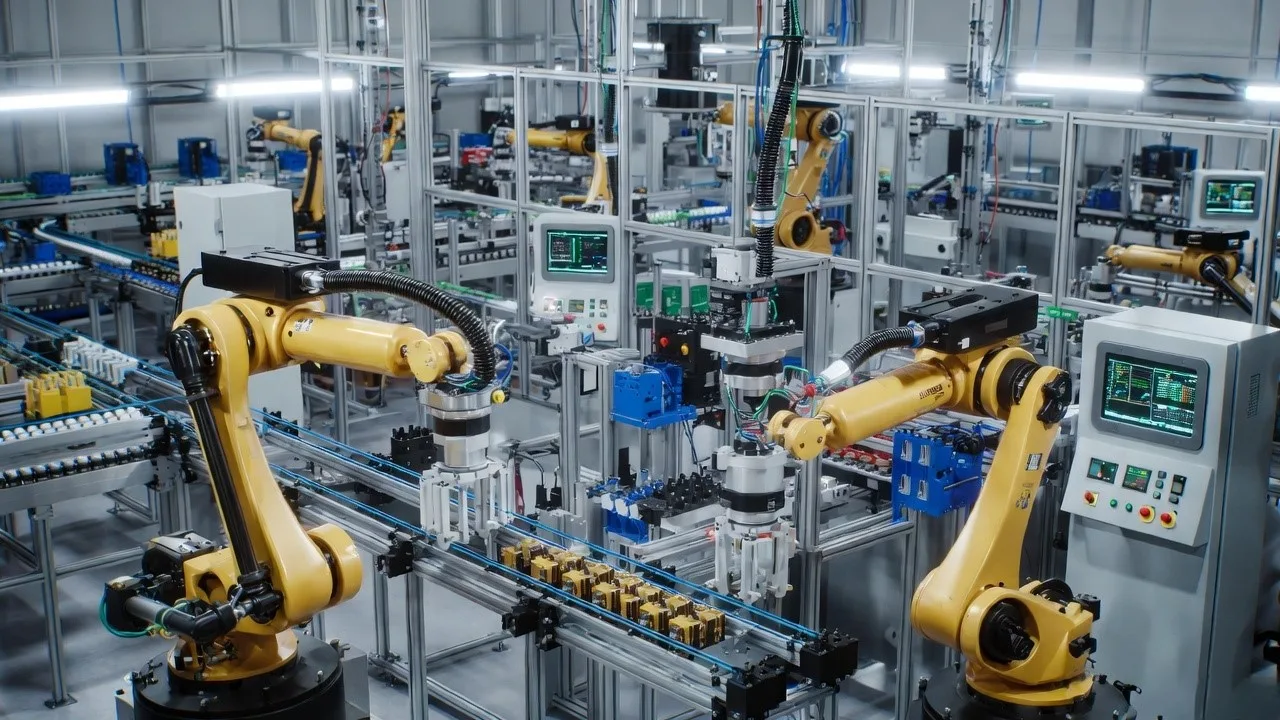
Traditional automation once meant installing machines like PLCs, robots, and SCADA systems to handle repetitive factory tasks. These tools are still important, but today’s automation consulting goes much further. Modern consulting connects every part of production machines, systems, and data so factories can run smarter, adapt faster, and continuously improve.
Automation consulting now covers the full journey from planning to execution. Consultants start by assessing current operations and identifying where automation will have the greatest impact. They then design and integrate the right mix of technologies robotics, AI, IoT, and analytics to create connected, flexible production environments.
Typical services include:
- Automation strategy and assessment: finding the best areas to automate.
- Process optimization: improving workflows before new systems are added.
- System integration and implementation: connecting hardware and software to work together.
- Custom solutions: building automation for unique production needs.
- Training and support: helping teams use and maintain new systems effectively.
When done well, automation consulting delivers measurable results. Manufacturers often see 15–30% gains in equipment efficiency, fewer production errors, and improved worker safety. Automation also boosts productivity, reduces waste, strengthens supply chains, and supports sustainability goals.
Key Technologies Driving the Next Wave of Manufacturing Automation
Modern manufacturing is changing fast, powered by new technologies that make production smarter, faster, and more efficient. These core technologies form the foundation for the next stage of industrial automation in the United States.
1. Industrial Robotics and Automation Systems
- Robots are becoming more capable with better vision, flexibility, and easier programming.
- The global robotics market is growing by about 12% each year from 2025 to 2034.
- Robots now handle complex assembly, inspection, and packaging tasks not just welding or material handling.
- Collaborative robots (cobots) work safely beside humans, making automation more accessible for smaller manufacturers.
2. Artificial Intelligence and Machine Learning
- AI helps factories predict equipment issues, improve quality, and optimize workflows.
- Machine learning uses real-time data to uncover patterns humans might miss.
- Some AI agents can adjust production automatically based on materials, environment, and equipment performance.
- In practice, these systems can boost yield and throughput by 8–12%.
3. Industrial Internet of Things (IIoT) and Smart Sensors
- IIoT connects machines and systems, giving full visibility into operations.
- Smart sensors track performance, quality, and environmental data in real time.
- These systems support predictive maintenance, energy efficiency, and live production monitoring.
- In 2024, sensors made up about 23% of the total industrial automation market showing their growing importance.
4. Agentic AI and Autonomous Systems
- Agentic AI takes automation a step further by acting independently, not just reacting to human input.
- These AI agents can set goals, plan tasks, make decisions, and coordinate across multiple systems.
- They’re especially useful in areas like production scheduling, quality control, and maintenance planning, where coordination is key.
- Real-world deployments show that agentic AI helps unify disconnected systems, improving overall efficiency.
People Also Ask: Manufacturing Automation Consulting Services
What is the typical ROI timeline for manufacturing automation projects?
The return on investment timeline varies significantly based on project scope and complexity, but well-executed automation initiatives typically deliver measurable returns within 12-24 months . Targeted projects focusing on specific high-impact processes can show returns in as little as 6-9 months, while comprehensive transformations may require 24-36 months to fully realize benefits. Factors influencing ROI timeline include project scale, process complexity, customization requirements, and organizational readiness for change.
How does automation consulting differ from traditional manufacturing consulting?
Automation consulting specifically focuses on integrating advanced technologies like robotics, AI, and IoT into production processes, while traditional manufacturing consulting typically addresses broader operational improvements including lean manufacturing, supply chain optimization, and quality management . Automation consultants combine technical expertise with operational knowledge to implement technology solutions that enhance productivity, reduce errors, and enable data-driven decision making across manufacturing environments.
What are the hidden costs of manufacturing automation?
Beyond obvious equipment and software expenses, manufacturers should budget for integration with existing systems, workforce training, maintenance and support, cybersecurity enhancements, and potential facility modifications . Additional hidden costs often include data preparation and management, ongoing software licensing fees, and change management activities. Comprehensive cost planning should also account for potential production disruptions during implementation and the need for ongoing optimization after initial deployment.
Can small to mid-sized manufacturers benefit from automation consulting?
Absolutely—small to mid-sized manufacturers often benefit significantly from targeted automation consulting that helps them implement appropriate technologies matching their scale, budget, and operational requirements . Consulting firms like RSM US specifically focus on serving mid-market companies, helping them implement cost-effective automation solutions that address specific pain points without requiring enterprise-level investments. Progressive automation approaches allow smaller manufacturers to start with focused implementations that deliver quick wins while building toward more comprehensive transformation.
How is AI changing manufacturing automation consulting?
AI technologies, particularly agentic AI, are transforming consulting services by enabling more sophisticated, autonomous systems that can manage complex workflows, predict issues, and continuously optimize processes . Consultants now integrate AI capabilities throughout manufacturing operations, from predictive maintenance and quality control to supply chain optimization and energy management. This shift requires consulting partners to possess both traditional operational expertise and advanced technical capabilities in AI development and implementation.
NunarIQ — The All-in-One AI Agent Platform Driving Efficiency, Precision, and Growth
NunarIQ equips GCC enterprises with AI agents that streamline operations, cut 80% of manual effort, and reclaim more than 80 hours each month, delivering measurable 5× gains in efficiency.
Industries
- Logistics
- Retail
- Manufacturing
- Healthcare
- Finance
- Energy & Resources
Resources
- Blogs
- Whitepaper
- Knowledge Base
- AI Agent Requirement Analysis