
Table of Contents
RFQs Are Quietly Limiting How Fast Logistics and Distribution Teams Can Respond
In logistics operations and B2B distribution businesses, RFQs are treated as routine work. Emails arrive. Attachments are opened. Line items are read. Details are re-entered into ERP or Excel. Quotes are prepared. The day moves on.
Nothing appears broken.
But under the surface, RFQs quietly determine how fast teams can respond, how much volume they can handle, and how much pressure people carry every single day.
The Bottleneck Most Teams Don’t Measure
RFQs arrive continuously:
- Customer RFQs for routes, vessels, or shipments
- Vendor RFQs for pricing and availability
- Project-driven RFQs with tight turnaround expectations
Each RFQ typically takes 8–20 minutes to process manually:
- Reading emails and attachments
- Interpreting inconsistent formats
- Extracting item tables
- Correcting data before ERP entry
Individually, this feels manageable.
At scale, it is not.
For teams handling 50–100 RFQs per day, this quietly translates into 10–25 hours of manual effort every day, before any pricing decisions or customer responses even begin.
This work rarely appears on dashboards, but it silently caps operational capacity.
Why RFQs Don’t Scale with the Business?
When RFQ volumes increase, most teams respond in familiar ways:
- Add people
- Extend working hours
- Accept slower response times
None of these actually fix the underlying issue.
RFQs depend entirely on human availability. When people are busy, RFQs wait. When backlogs form, response quality drops. Growth continues, but the RFQ process becomes fragile.
Over time, skilled coordinators and pricing teams spend most of their day on clerical work instead of judgment-driven tasks.
What Changes When RFQs Become Autonomous?
At Nunar, we treat RFQs as an operational layer, not a document task.
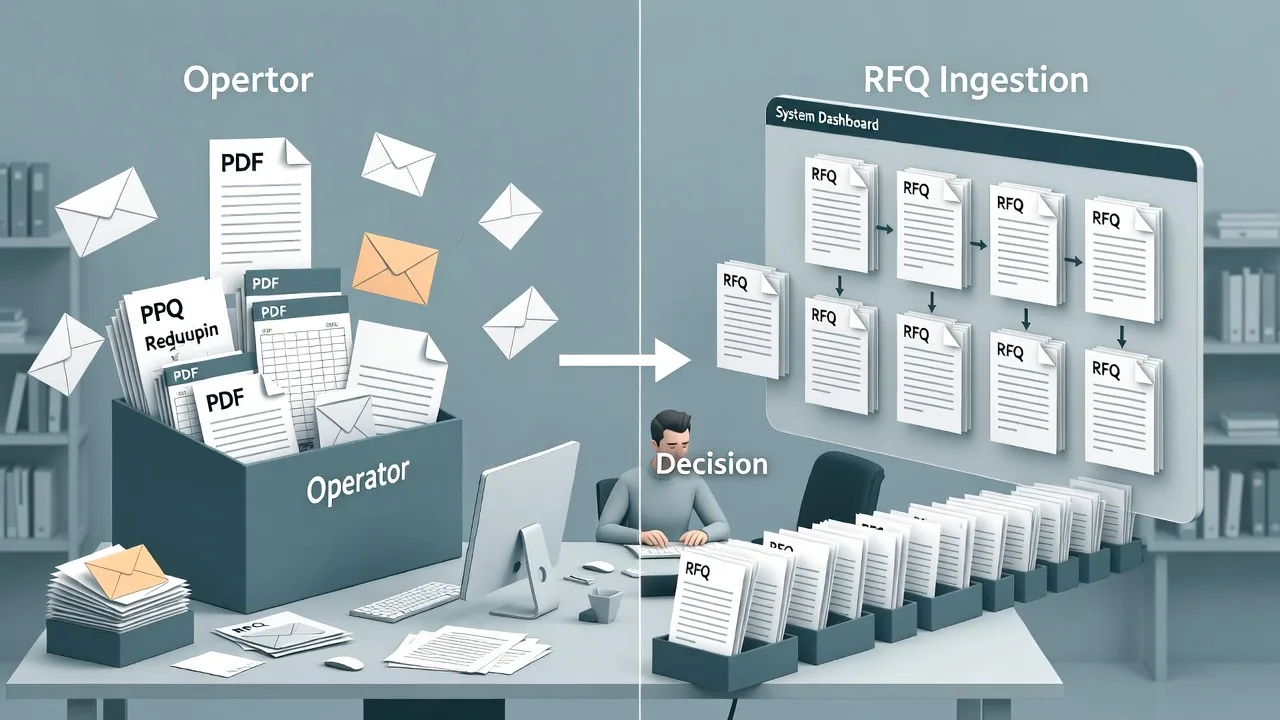
Agentic AI changes the model by taking ownership of RFQ ingestion end to end:
- Monitoring RFQ inboxes continuously
- Detecting and pulling attachments automatically
- Understanding documents across formats
- Extracting item-level data accurately
- Validating and normalizing information
- Preparing structured outputs for ERP ingestion
The workflow runs independently, without waiting for people, shifts, or manual queues.
RFQs move forward even when teams are busy.
The Impact Teams Actually Feel
Across logistics operators and B2B distributors we work with, automating RFQ ingestion typically reduces manual effort by 70–80%.
That reclaimed capacity does not disappear. It gets redirected:
- Pricing teams focus on complex or high-value RFQs
- Coordinators manage more lanes and customers without overload
- Trading teams respond faster to vendors and projects
- Customer teams spend time on exceptions, not data entry
Operations become calmer, more predictable, and easier to manage at scale.
A Small Change with a Compounding Effect
When routine RFQ work is handled autonomously, teams can handle 30–50% more RFQs with the same headcount, without extending working hours or compromising accuracy.
The benefit is not just speed.
It is consistency, visibility, and sustainability.
RFQs may look like a small operational detail, but they sit at the front door of revenue flow. Removing manual friction here unlocks capacity across the operation.
The Nunar RFQ Ingestion Pipeline
Nunar enables this through a structured, production-ready pipeline designed for real operational environments:
- Email Monitoring – RFQ inboxes are tracked continuously
- Attachment Detection – Relevant documents are identified automatically
- Document Understanding – Vision AI and OCR interpret tables and formats
- Item Extraction – RFQ line items and key fields are captured
- Validation – Data is checked, normalized, and prepared
- Structured Output – Clean JSON is generated for downstream systems
- ERP Delivery – Data is provided in ERP-ready formats
This is not a one-off automation.
It is a repeatable ingestion layer built for volume, variation, and growth.
Automation That Respects Human Judgment
The goal is not to remove people from RFQ workflows.
The goal is to remove repetition.
When routine RFQs move on their own, humans focus on decisions, exceptions, and customer commitments. Operations become more resilient, and growth stops feeling like pressure.
At Nunar, we believe operational speed should come from system design, not human exhaustion.
NunarIQ — The All-in-One AI Agent Platform Driving Efficiency, Precision, and Growth
NunarIQ equips GCC enterprises with AI agents that streamline operations, cut 80% of manual effort, and reclaim more than 80 hours each month, delivering measurable 5× gains in efficiency.
Industries
- Logistics
- Retail
- Manufacturing
- Healthcare
- Finance
- Energy & Resources
Resources
- Blogs
- Whitepaper
- Knowledge Base
- AI Agent Requirement Analysis