
RFQs Are Quietly Limiting How Fast UAE Freight Forwarders Can Respond
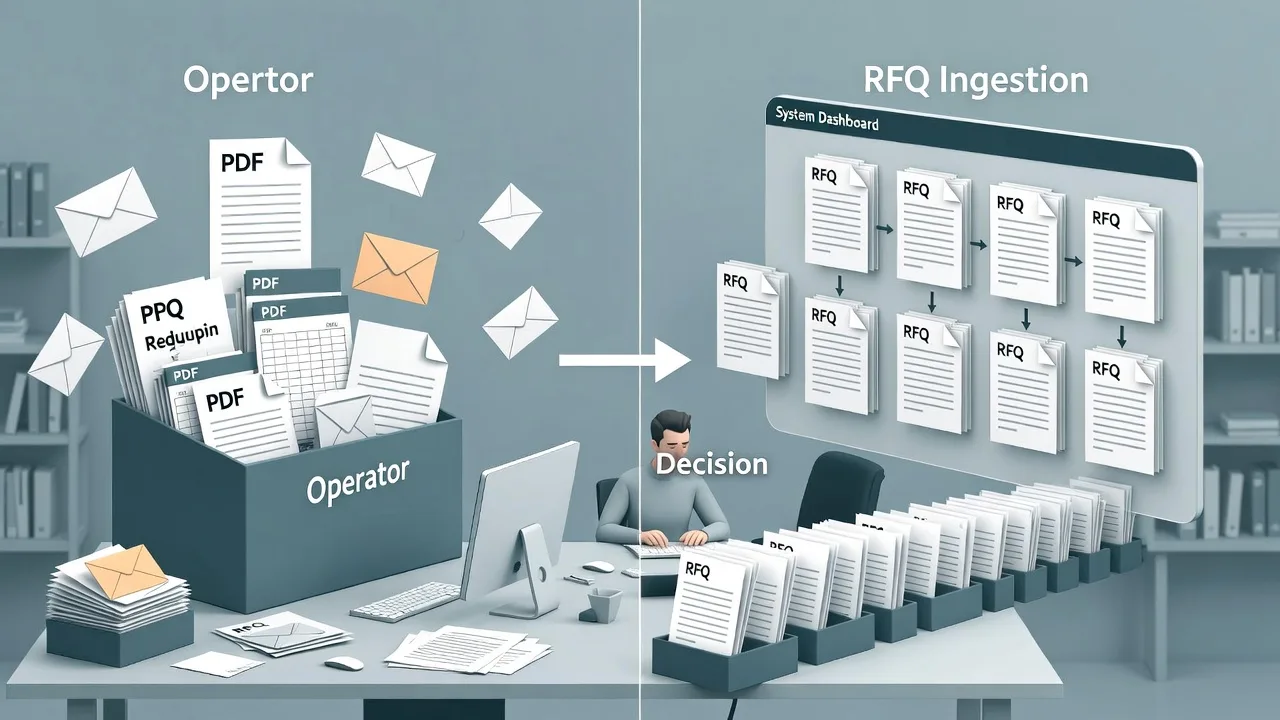
In logistics operations and B2B distribution businesses across the UAE and GCC, RFQs are treated as routine work. Emails arrive. Attachments are opened. Line items are read. Details are re-entered into ERP or Excel. Quotes are prepared. The day moves on.
Nothing appears broken.
But under the surface, RFQs quietly determine how fast teams can respond, how much volume they can handle, and how much pressure people carry every single day.
For logistics operators running out of Dubai, Jebel Ali, or Sharjah — where trade volumes are among the highest in the MENA region — this is not a small problem. Dubai alone handles over 14 million TEUs annually through Jebel Ali Port, the largest port in the Middle East. Behind every shipment is a chain of RFQs, quotes, and vendor responses. When that chain slows down, the entire operation feels it.
The Bottleneck UAE Freight Teams Don’t Measure
RFQs arrive continuously in UAE logistics and distribution operations:
- Customer RFQs for freight routes, sea freight, or air cargo from Dubai World Central
- Vendor RFQs for pricing, trucking, customs clearance, and last-mile delivery
- Project-driven RFQs with tight turnaround expectations tied to UAE free zone timelines
- Cross-border RFQs between UAE, Saudi Arabia, Oman, and other GCC trade corridors
Each RFQ typically takes 8–20 minutes to process manually:
- Reading emails and attachments
- Interpreting inconsistent formats (Arabic and English, PDF and Excel)
- Extracting item tables with varying column structures
- Correcting data before ERP entry
- Chasing clarifications when details are incomplete
Individually, this feels manageable.
At scale, it is not.
For teams handling 50–100 RFQs per day, this quietly translates into 10–25 hours of manual effort every day, before any pricing decisions or customer responses even begin. This work rarely appears on dashboards, but it silently caps operational capacity.
Why UAE Logistics Teams Feel This More Acutely
The UAE logistics sector operates at a pace and complexity that amplifies RFQ friction. Three factors make it worse here than in most markets:
1. Bilingual document processing
RFQs arrive in Arabic, English, and mixed formats. A vendor in Deira sends a PDF in Arabic. A freight forwarder in JAFZA sends a spreadsheet in English. A customer from Saudi Arabia sends a hybrid document. Manual teams lose time — and make errors — switching between formats and languages.
2. Multi-corridor complexity
UAE logistics operations regularly handle GCC overland corridors, sea freight through Khalifa Port and Jebel Ali, air freight through Dubai World Central and Abu Dhabi Airport, and cross-border free zone documentation. Each corridor has different rate structures, accessorial charges, and documentation requirements. Every RFQ requires someone to know which rules apply.
3. Peak pressure during Dubai trade seasons
GITEX, Dubai Expo events, Ramadan retail surges, and Q4 peak season create concentrated RFQ spikes. Teams that operate at near-capacity during normal weeks hit a wall during peaks. Response times stretch. Quotes are delayed. Customers move on.
Why RFQs Don’t Scale for UAE Freight Forwarders
When RFQ volumes increase, most UAE logistics teams respond in familiar ways:
- Add people
- Extend working hours
- Accept slower response times
None of these actually fix the underlying issue.
RFQs depend entirely on human availability. When people are busy, RFQs wait. When backlogs form, response quality drops. Growth continues, but the RFQ process becomes fragile.
Over time, skilled coordinators and pricing teams spend most of their day on clerical work instead of judgment-driven tasks. The cost is not just time — it is the opportunity cost of experienced people doing work that a system could handle.
| RFQ Volume (per day) | Manual Processing Time | FTEs Required (manual) | FTEs Required (automated) |
|---|---|---|---|
| 25–50 RFQs | 4–10 hours/day | 1–2 | 0.25 |
| 50–100 RFQs | 10–25 hours/day | 2–4 | 0.5 |
| 100–200 RFQs | 20–50 hours/day | 4–8 | 1–1.5 |
The math does not change with headcount. It only changes with automation.
What Changes for UAE Freight When RFQs Become Autonomous
At Nunar, we treat RFQs as an operational layer, not a document task. Our RFQ-to-ERP automation changes the model by taking ownership of RFQ ingestion end to end:
- Monitoring RFQ inboxes continuously — including shared mailboxes used by UAE operations teams
- Detecting and pulling attachments automatically regardless of format
- Understanding documents across formats, including Arabic PDFs and mixed-language spreadsheets
- Extracting item-level data accurately — quantities, units, specifications, delivery location
- Validating and normalising information before ERP entry
- Preparing structured outputs compatible with SAP, Oracle, Microsoft Dynamics, and other ERP systems common in UAE enterprises
The workflow runs independently, without waiting for people, shifts, or manual queues. RFQs move forward even when teams are busy, even outside office hours, and even during peak season.
The Nunar RFQ Ingestion Pipeline
Nunar enables this through a structured, production-ready pipeline designed for real operational environments in the UAE and GCC region:
Step 1: Email Monitoring
RFQ inboxes are tracked continuously. The system monitors shared mailboxes, vendor email threads, and customer portals — covering all the channels your team currently checks manually.
Step 2: Attachment Detection and Classification
Relevant documents are identified and classified automatically. The AI agent differentiates between RFQ documents, supporting attachments, and irrelevant emails — without training on rigid templates.
Step 3: Document Understanding
Vision AI and OCR interpret tables and formats, including:
- Arabic-language PDFs and documents
- Scanned paper RFQs from legacy vendors
- Multi-page Excel workbooks with item tables
- Inconsistently formatted documents from different GCC markets
Step 4: Item-Level Extraction
RFQ line items and key fields are captured: item descriptions, quantities, units of measure, delivery location (including UAE free zone, port, or warehouse), requested delivery dates, and any special instructions.
Step 5: Validation and Normalisation
Extracted data is checked against known vendor formats, historical RFQ patterns, and business rules. Common issues — unit mismatches, missing fields, duplicate entries — are flagged before the data reaches the ERP.
Step 6: Structured Output and ERP Delivery
Clean, structured JSON is generated and delivered in ERP-ready formats. Integration with SAP S/4HANA, Oracle Fusion, Microsoft Dynamics 365, and other enterprise systems ensures data flows directly into procurement workflows without re-entry.
The Impact UAE Teams Actually Feel
Across logistics operators and B2B distributors we work with in the UAE and GCC, automating RFQ ingestion typically reduces manual effort by 70–80%.
That reclaimed capacity does not disappear. It gets redirected:
- Pricing teams focus on complex or high-value RFQs — the ones that actually require commercial judgment
- Coordinators manage more lanes and customers without overload
- Trading teams respond faster to vendors and projects, improving win rates on time-sensitive GCC opportunities
- Customer teams spend time on exceptions and relationships, not data entry
- Operations become calmer, more predictable, and easier to manage at scale
A Typical Before/After for a UAE Logistics Operator
| Metric | Before Automation | After Automation |
|---|---|---|
| Time per RFQ (manual entry) | 8–20 minutes | Under 2 minutes (review only) |
| Daily RFQ capacity (same team) | 50–60 RFQs | 150–200 RFQs |
| Response time to customers | 4–8 hours | Under 1 hour |
| Manual effort in RFQ process | 80%+ | Less than 20% |
| Error rate in ERP data entry | 3–5% | Near zero |
How RFQ Automation Connects to UAE Freight AP Workflows
RFQ automation does not operate in isolation. For UAE logistics enterprises building end-to-end AI capabilities, RFQ ingestion feeds directly into downstream financial workflows.
When RFQ data is structured and accurate from the start:
- Purchase orders are generated with correct line items and pricing
- Vendor invoices can be validated automatically against the original RFQ and PO — a critical step for AP OCR and invoice matching
- Three-way matching (RFQ → PO → invoice) becomes reliable rather than a manual chore
- UAE VAT 5% is applied correctly from the RFQ stage, reducing downstream tax corrections
This is why leading UAE logistics operators are building RFQ automation and AP automation as connected capabilities, not separate projects.
A Small Change with a Compounding Effect
When routine RFQ work is handled autonomously, teams can handle 30–50% more RFQs with the same headcount, without extending working hours or compromising accuracy.
The benefit is not just speed. It is consistency, visibility, and sustainability.
RFQs may look like a small operational detail, but they sit at the front door of revenue flow. In a market as competitive as UAE logistics — where response time often determines whether a customer sends the next enquiry to you or a competitor — removing manual friction here unlocks capacity across the entire operation.
Automation That Respects Human Judgment
The goal is not to remove people from RFQ workflows. The goal is to remove repetition.
When routine RFQs move on their own, humans focus on decisions, exceptions, and customer commitments. Operations become more resilient, and growth stops feeling like pressure.
At Nunar, we believe operational speed should come from system design, not human exhaustion. If you’d like, we can share a simple RFQ capacity calculator that shows how much time and response bandwidth your current volumes consume each week.
People Also Ask
What is RFQ automation in logistics?
RFQ (Request for Quote) automation uses AI agents to monitor inboxes, extract data from attachments, validate and normalise line items, and deliver structured data to ERP systems — without manual data entry. It replaces the clerical layer of RFQ processing while preserving human judgment for pricing and commercial decisions.
How does RFQ automation work with Arabic documents?
Modern RFQ automation systems trained for UAE and GCC markets use OCR and Vision AI capable of reading Arabic text, right-to-left formatting, and mixed Arabic/English documents. This is critical for UAE logistics teams dealing with vendor documents in Arabic from local and regional suppliers.
How much time does RFQ automation save for a UAE logistics team?
Teams typically save 70–80% of manual RFQ processing time. For a team handling 100 RFQs per day at 10–15 minutes each, that translates to 12–20 hours of recovered capacity daily — the equivalent of 1.5–2.5 full-time employees.
Can RFQ automation integrate with SAP, Oracle, or Microsoft Dynamics?
Yes. Enterprise RFQ automation systems generate structured outputs compatible with major ERP platforms including SAP S/4HANA, Oracle Fusion, and Microsoft Dynamics 365 — all common in large UAE enterprises. Data is delivered in ERP-ready formats without re-entry.
Is RFQ automation suitable for UAE free zone logistics operations?
Yes. Free zone operations in JAFZA, DAFZA, KIZAD, and other UAE free zones often have high RFQ volumes across multiple corridors. Automation is particularly valuable here because of the diversity of vendor documents and the speed requirements of free zone trade.
How long does it take to implement RFQ automation?
Initial deployment typically takes 4–8 weeks, starting with email monitoring and extraction on your highest-volume RFQ inboxes. Most teams see measurable time savings within the first two weeks of go-live. Full integration with ERP and procurement workflows is typically complete within 8–12 weeks.