
Table of Contents
AI File Viewer: How AI Agents Revolutionize US Logistics from File Viewer to Factory Floor?
One of the largest headaches for any freight forwarder or 3PL in the United States isn’t a lack of trucks or a port closure, it’s the sheer, unmanageable volume of unstructured data. A recent industry report noted that up to 80% of logistics data is trapped in documents like freight invoices, bills of lading, and customs forms, costing US logistics businesses hundreds of millions of dollars annually in manual processing and delays. This is the world I operate in. As the founder of an AI Agent Development Company, I’ve spent the last decade building systems that move beyond simple automation. My team and I have developed and successfully deployed over 500 AI agents in production for companies, from mid-market distributors in the Midwest to global e-commerce fulfillment centers on the West Coast.
We are not just talking about chatbots or basic data capture. We are talking about highly autonomous, goal-oriented systems, true digital workers, that can read, reason, and act across complex enterprise systems. For U.S. logistics companies, the shift from manual data management to agentic AI is not optional; it’s the only way to remain competitive in a landscape defined by razor-thin margins and intense customer demands.
This deep-dive is based on my firsthand experience scaling agent deployments. We will walk through the critical role of AI in processing unstructured logistics data, show how truly autonomous AI agents function within dynamic environments, and detail the exact, step-by-step process, using a tool like n8n, to build these powerful, time-saving workflows.
The shift from simple document capture to autonomous, goal-driven AI agents is the single greatest opportunity for U.S. logistics companies to reduce operational friction and save hundreds of millions of dollars annually.
From Paper to Process: The Critical Role of the AI File Viewer in Logistics Workflows
The logistics industry lives and dies by its documents. The journey of a single international shipment involves a cascade of PDFs, scans, and emails: the Commercial Invoice, the Packing List, the Bill of Lading (BOL), the Certificate of Origin, and more. Each document contains mission-critical data, SKUs, weights, dimensions, customs codes, and receiver addresses, that must be manually extracted and input into a Transportation Management System (TMS), an Enterprise Resource Planning (ERP) system, or a Warehouse Management System (WMS). This process is slow, costly, and riddled with human error.
The Unstructured Data Barrier in U.S. Supply Chains
For U.S. manufacturers and 3PLs managing global supply chains, the document flow is compounded by varied international formats and strict domestic compliance requirements.
- Customs Delays: A single error in an Automated Export System (AES) filing or a late submission of a required Importer Security Filing (ISF) can halt a shipment at a U.S. port, incurring thousands in demurrage and detention fees.
- Invoice Discrepancies: Auditing thousands of freight invoices monthly from various carriers is an administrative nightmare, leading to overpayment and missed savings.
- Lack of Visibility: Critical data remains locked in an email attachment until a human opens it, which means real-time visibility is often just “yesterday’s data.”
How an AI Agent Transforms Document Processing
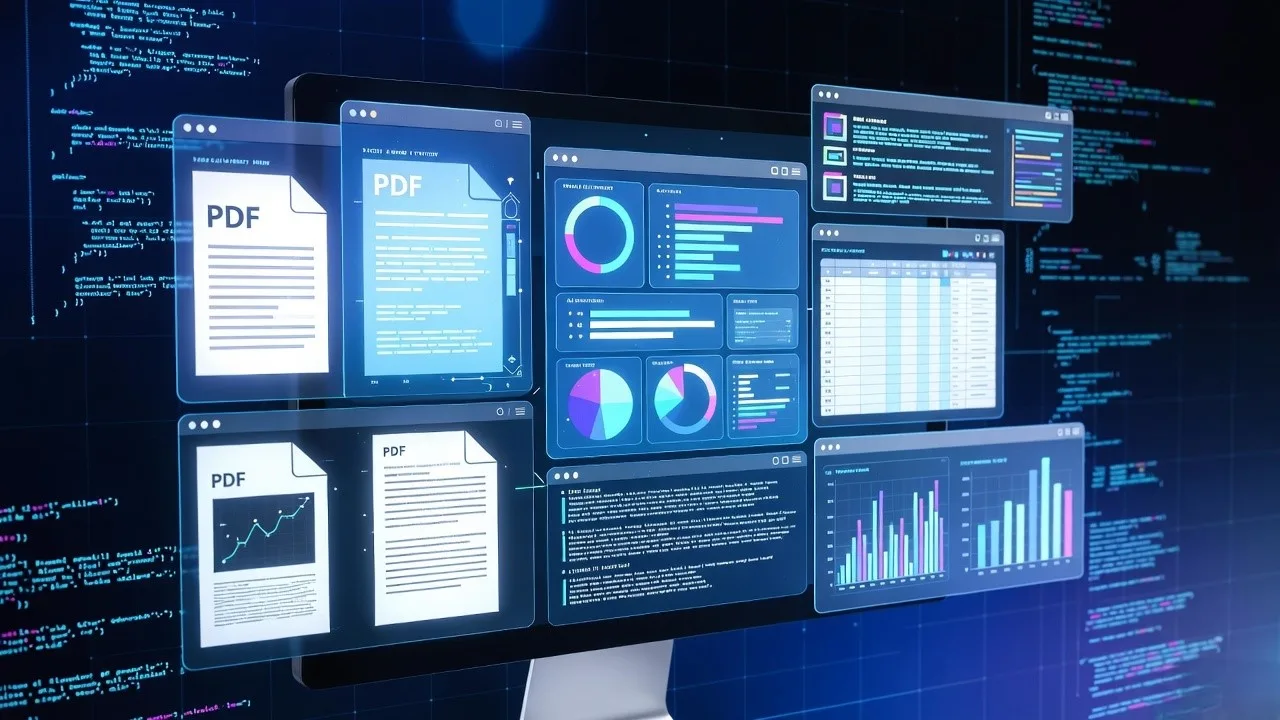
The first, foundational agent we build is often the AI File Viewer Agent. It’s the essential tool that turns a mountain of documents into actionable, structured data, saving significant time and resources.
- Perception (The View): The agent autonomously monitors digital folders, email inboxes, or API feeds from carrier portals. It uses Computer Vision (CV) to “see” documents and Generative AI (GenAI) to “read” the text, regardless of the document’s format (PDF, image, even a grainy fax scan).
- Reasoning (The Interpretation): Unlike simple Optical Character Recognition (OCR), the AI agent reasons about the meaning of the data. It doesn’t just extract “100” and “units”, it recognizes that “100 units” is the quantity for SKU #456, which is linked to Order #ABC, which needs to be routed to a California fulfillment center.
- Action (The Input): Once validated, the agent automatically populates the fields in the TMS or ERP, triggers the next process (like creating a delivery order), and files the original document in the appropriate digital folder.
Case Example: The Freight Invoice Auditor Agent
One of our clients, a large distributor operating across the United States, reduced their invoice processing time by 92% using this type of agent. The agent processes 1,500+ invoices daily, flagging discrepancies against contracted rates and purchase orders for human review. This is not just automation; it is an autonomous, real-time audit function that previously required five full-time employees. The cost savings were substantial, demonstrating the immediate ROI of an intelligent AI File Viewer.
Agentic Workflows: How Autonomous AI Agents Drive Operational Savings
An AI agent is not a pre-programmed script. It’s a software entity designed with a goal and the tools to autonomously figure out the best sequence of actions to achieve that goal. Our experience in deploying over 500 AI agents has proven that this autonomous, goal-driven architecture is the only way to deliver true operational transformation.
Autonomous AI Agents vs. Simple Automation
| Feature | Simple RPA/Script | Autonomous AI Agent | Impact for US Logistics |
| Goal | Follow pre-defined, rigid steps. | Achieve a high-level goal (e.g., “Minimize shipment delay”). | Proactive risk mitigation; saves days of downtime. |
| Data Ingestion | Structured data only (API, CSV). | Unstructured (PDF, email, image) and structured data. | Eliminates manual data entry for 80% of logistics documents. |
| Adaptability | Fails if an input/step changes. | Reasons, adapts, and uses tools to recover from errors. | Handles dynamic, real-world events (traffic, weather, port strikes). |
| Tools | Limited to built-in functions. | Can use any connected system (Google Maps, TMS, Weather API, n8n). | Creates end-to-end, integrated workflows across the enterprise. |
Comparison of Autonomous Agent Use Cases in US Logistics
The decision to adopt agentic AI is a strategic one, focused on reallocating human capital from reactive, manual work to strategic, proactive planning. Here is a comparison of three high-impact agents we deploy for our global IT buyers and U.S. manufacturing clients:
| Agent Focus | Key Metric Impacted | Primary Data Sources | Time Saved / Impact | Nunar Agent Goal |
| Freight Audit Agent | Accuracy & Spend | Carrier Invoices (PDF/Scans), Rate Cards, Purchase Orders (TMS/ERP) | 90%+ reduction in invoice processing time; 3–5% cost savings on carrier over-billing. | Ensure 100% compliance with contracted rates and terms. |
| Inventory Predictor Agent | Stockout Rate & Capital | Sales History, Weather Data, Geo-Specific Social Trends, Supplier Lead Times | 15–20% increase in demand forecast accuracy; freeing up 10%+ in working capital. | Optimize inventory levels to maximize fill rate and minimize holding cost. |
| Dispatch Coordinator Agent | Delivery Efficiency & SLA | Real-Time GPS/Telematics, Traffic APIs, Driver Hours-of-Service (HOS), Urgent Order Queues | 20%+ reduction in empty miles and idle time; 25% faster response to unexpected delays. | Dynamically allocate drivers and routes to guarantee on-time delivery. |
The Path to Autonomous Logistics
The logistics industry in the United States is entering a new era. The complexity of modern supply chains, from multi-modal transport to strict compliance and the ever-present demand for speed, can no longer be managed effectively with fragmented, human-driven processes. The greatest friction and cost lie not in the physical movement of goods, but in the manual processing of the data that governs that movement.
Our work at Nunar, deploying over 500 AI agents in production, confirms that the autonomous AI agent is the most powerful tool for overcoming this challenge. It moves beyond simple task automation by enabling machines to read, reason, and autonomously act on complex, unstructured data, from the simplest AI File Viewer function to full, dynamic fleet orchestration. By integrating the power of an LLM with the deterministic control of a platform like n8n, we can save your business from the millions of dollars lost to human error, delays, and inefficiency.
This is the competitive edge in the 21st century: a resilient, self-optimizing supply chain.
Do you have a bottleneck in your U.S. logistics operation—a flood of unstructured documents, persistent route inefficiencies, or costly invoice audits? Contact Nunar today for a strategic consultation on how a bespoke AI agent deployment can deliver a measurable 6-month ROI.
People Also Ask
How do AI agents improve demand forecasting for logistics companies?
AI agents improve demand forecasting by correlating historical sales data with non-linear, external variables such as weather patterns, social media trends, geopolitical events, and competitor promotional data, leading to a 15–20% increase in forecast accuracy and a reduction in stockouts and overstocking.
Can AI agents manage compliance and customs documentation automatically?
Yes, AI agents are increasingly used to automate customs documentation by reading unstructured regulatory updates and internal compliance documents, ensuring that every required field on a customs form (like the HTS Code) is accurately populated and submitted on time, significantly reducing customs clearance delays at U.S. borders.
What is the typical ROI for deploying an AI agent in a logistics operation?
The typical ROI for a well-designed AI agent in a logistics operation is often achieved within 6 to 12 months, primarily through cost savings from reduced manual data entry, a 10–15% reduction in transportation costs via better route optimization, and significant cost avoidance from preventing equipment downtime and service failure penalties.
NunarIQ — The All-in-One AI Agent Platform Driving Efficiency, Precision, and Growth
NunarIQ equips GCC enterprises with AI agents that streamline operations, cut 80% of manual effort, and reclaim more than 80 hours each month, delivering measurable 5× gains in efficiency.
Industries
- Logistics
- Retail
- Manufacturing
- Healthcare
- Finance
- Energy & Resources
Resources
- Blogs
- Whitepaper
- Knowledge Base
- AI Agent Requirement Analysis